Amnesia: The Dark Descent Is Still the Best Horror Game Ever Made. Nothing Has Come Close.
Fourteen years old. Still terrifying. The reason every indie horror game since 2010 exists. Here's why Amnesia remains the benchmark nobody has matched.

TL;DR
- 14 years old and still, by this argument, the most effectively terrifying game ever made.
- No weapons, no combat -- vulnerability and a sanity meter do all the work.
- Directly influenced Outlast, SOMA, Signalis, and most vulnerability-first horror made since.
- $9.99, frequently on sale for a few dollars.
Buy it. $9.99 on Steam. Frequently on sale for under $3. If you have not played it, stop reading and go buy it. Come back after. If you have played it, you already know what I am about to say.
Amnesia: The Dark Descent came out in 2010. Frictional Games made it on a budget that a modern AAA publisher would spend on a single cutscene. It is still, in 2026, fourteen years later, the most effectively terrifying game ever made. Not the goriest. Not the most technically accomplished. The most terrifying.
I have played horror games for over twenty years. I have played every significant entry in the genre across that time. Amnesia still gets to me in ways that nothing else has matched. The specific quality of fear it produces, sustained, accumulative, psychological rather than reactive, is something I have encountered nowhere else in the decade and a half since it launched.
The Design That Changed Everything
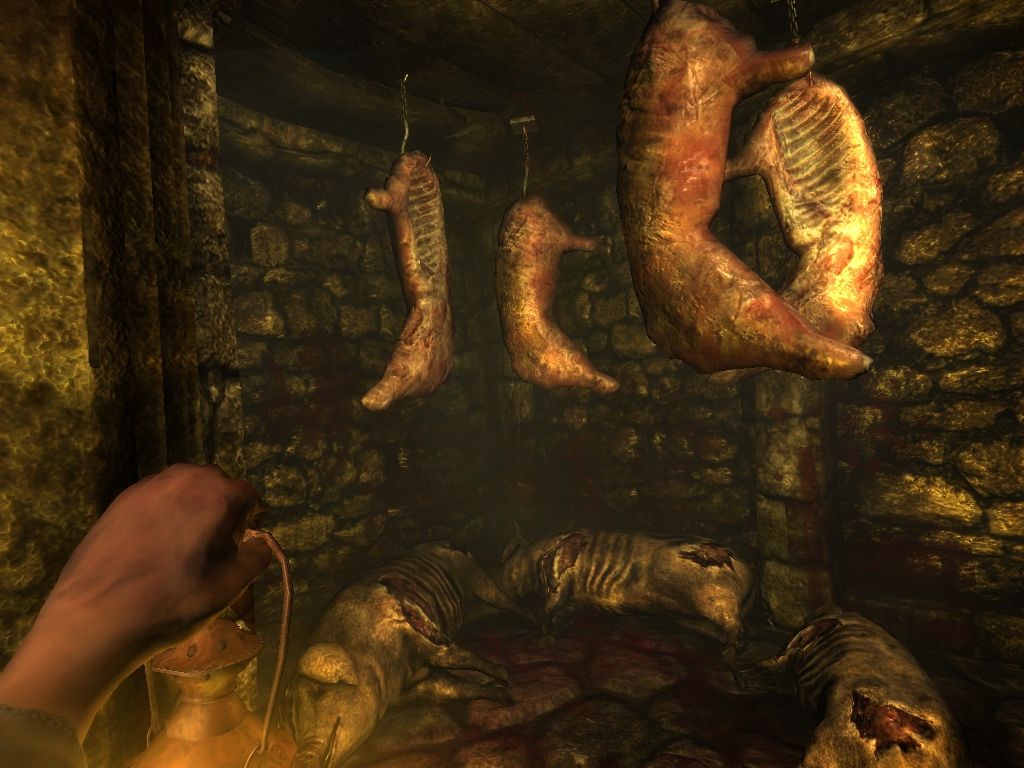
Amnesia gives you no weapons. You cannot fight. You cannot kill anything. When a monster finds you, your available responses are: run, hide, and do not look at it.
The not looking at it is the mechanic that makes everything else work.
Daniel has a sanity meter. Look at monsters too long and it deteriorates. Stay in darkness too long and it deteriorates. When sanity drops far enough, the screen distorts, Daniel begins muttering to himself, and things start appearing in the environment that may or may not be there. You cannot fully distinguish what is real from what your character's deteriorating mind is generating.
This creates a category of horror that jump-scare games cannot replicate. You are not just scared of the monster. You are scared of what looking at the monster will do to your perception of reality. You are scared of darkness as an active threat rather than as atmosphere. You are scared of your own mind.
Frictional built Brennenburg Castle with this mechanic's logic running through every design decision. They give you just enough light to see what is immediately in front of you. Every corridor conceals something. Every sound could be a monster, could be the castle settling, could be your own sanity generating hallucinations. You cannot reliably distinguish these possibilities. That inability is the game.
What is remarkable about the sanity mechanic, even fourteen years later, is how cleanly it externalises psychological deterioration into mechanical consequences. The protagonist's mental state is not just flavour text or a story beat. It is a game system with direct effects on your perception of what is happening. When the game tells you, through distorted visuals and Daniel's whispers, that your grip on reality is weakening, it is not communicating this narratively. It is making you feel it through the mechanics. The medium is doing something that no other medium can do in quite the same way.
After fourteen years and hundreds of horror games in the genre Amnesia created, I have not found a design that handles psychological vulnerability this elegantly.
Why the Monster AI Still Works
The Gatherers, the monsters that patrol Brennenburg, do not follow scripted patrol routes. They move semi-randomly. They react to sound. When they identify a location where they heard something, they search it. When they find you in the open, they run toward you.
I want to pause on why this matters in the context of horror game design.
Games that place monsters constantly train you not to be scared. Your brain maps the patrol patterns. Once the patterns are mapped, they produce mild alertness rather than genuine fear. You are no longer encountering something dangerous. You are navigating a system you understand.
Amnesia's Gatherers appear infrequently. Each encounter carries genuine alarm because the last one was far enough away that you have not had time to fully map their behaviour. The unpredictability is maintained across the runtime through the semi-random movement rather than through scripted variation. By the time you hear one again, your body has mostly forgotten what the last encounter felt like.
The water sections, where you navigate flooded corridors with something living in the water that you cannot see, are among the most tense sequences I have experienced in any medium. You can hear it. You know it responds to movement through the water. The sound design tells you it is there without showing it. Your imagination constructs something worse than Frictional could have explicitly designed. The not-seeing is worse than seeing.
Frictional understood that player imagination is a co-author of horror. The design is built around activating imagination rather than replacing it. This is, honestly, the key insight that most horror games miss. You cannot design something scarier than what a specific player's imagination will generate. You can only give that imagination the right conditions and then get out of the way.
The Story Does Real Work
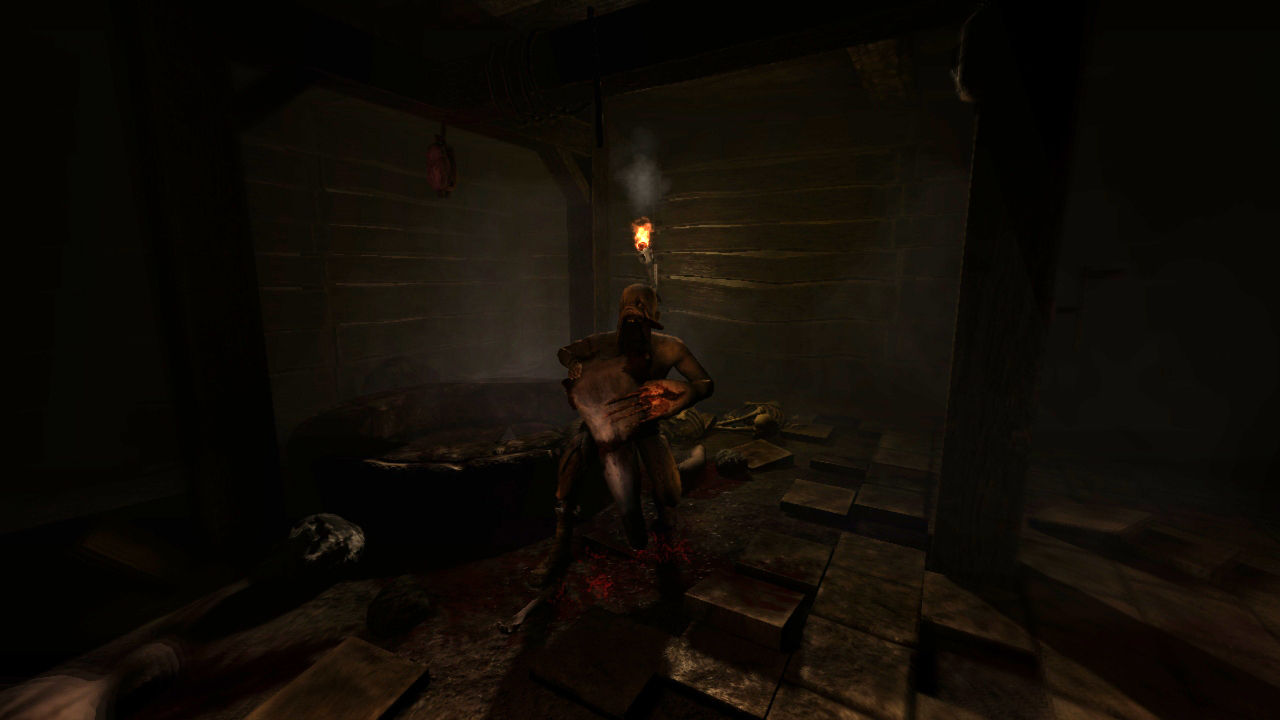
Most horror game narratives exist to justify the player's presence in the scary place. Amnesia's narrative is doing something more specific and more disturbing.
The story, delivered through Daniel's own notes and diary entries discovered throughout the castle, concerns his self-imposed amnesia, a deal made with something ancient and genuinely malevolent, and the specific actions Daniel took to maintain that deal. By the time you understand what Daniel did, the horror is not the monsters. It is what Daniel was.
Frictional understood something that most horror games do not: the most lasting horror is not the monster itself but the human being who created the conditions for the monster. The Gatherers are the immediate threat. What Daniel chose, and what he was willing to do to keep the deal intact, is the horror that remains after the game ends.
The game trusts you to assemble this from fragments rather than presenting it as exposition. The environmental storytelling, what is present in certain rooms, what condition it is in, what the notes' writing style communicates about Daniel's state when he wrote them, contributes as much as the text itself.
I want to be specific about the specific quality of dread the backstory produces, because it is different from the gameplay dread and it compounds it. During play, you are afraid of the Gatherers, of the dark, of what happens to Daniel's sanity. After play, you are afraid of what Daniel did in rooms you have already left. The horror extends backward through the environments you have already navigated once you understand what happened in them. Very few games achieve this retroactive quality of dread, where completing the game changes what you feel about what you have already experienced.
Brennenburg Castle as a Character
The specific quality of Brennenburg Castle as a horror environment deserves more attention than it typically receives in coverage of the game, because it is not simply a backdrop. It is a character.
The castle is old in a way the game communicates through its visual and structural logic. The architecture makes sense as architecture. The storage rooms are where storage rooms would be. The refinery has the logic of a functioning industrial space. The prison has the logic of a place where people were held. This internal coherence means the castle feels like a real place rather than a horror game level, and that reality is what makes being in it disturbing rather than merely threatening.
Frictional also built the castle to communicate what happened here before Daniel arrived. The condition of specific rooms, the objects present and absent, the evidence of things that were done in them, all assemble a picture of the castle's history that precedes the game's narrative. By the time you understand what the castle has been used for, you have spent hours in it developing an intuitive sense of its wrongness that the explicit revelations then confirm and deepen.
The pacing of the castle's sections is also worth noting. Frictional understood that sustained dread requires variation in intensity. The early sections are quiet by later standards, establishing the environment and its logic before introducing significant threats. The middle sections escalate systematically. The late sections are among the most unrelenting horror experiences in the medium. This pacing feels natural rather than designed because the castle itself provides the logic: you are going deeper, and deeper is where the worst things are.
I have replayed specific sections of Amnesia to try to understand how Frictional achieved specific effects. The water section remains the most instructive. Everything about it, the light level, the sound design, the movement physics, the creature's behaviour, is calibrated to produce a specific quality of dread that I find essentially impossible to rationally diminish even on replays. That is craft.
Why Amnesia's Sequels Could Not Follow It
Frictional made two sequels and one thematic successor. None achieved what the original achieved, and the reasons are worth understanding because they illuminate what specifically makes the original exceptional.
Amnesia: A Machine for Pigs, made by The Chinese Room rather than Frictional, removed the sanity meter and adjusted the inventory system. These were presented as design evolution decisions. The result was a game that looked like Amnesia and did not feel like Amnesia, because the sanity mechanic was not ornamental. It was the load-bearing element of the psychological horror system. Removing it produced a game that was atmospheric and not particularly frightening.
Amnesia: Rebirth, made by Frictional themselves, reintroduced the sanity mechanic and added a narrative ambition the original did not have. It is a good game. It is not frightening in the way the original is frightening, because the narrative structure requires character development across a sustained arc in ways that reduce the sustained vulnerability that makes the original work. You cannot build emotional investment in a protagonist and maintain pure vulnerability simultaneously. Frictional chose investment. The original chose vulnerability.
SOMA, also Frictional, made vulnerability a philosophical rather than physical property and produced something extraordinary in a different register. But SOMA is a different genre of game from Amnesia. It is horror that operates at the level of ideas rather than at the level of sustained physiological fear.
The original remains unreplicated because the specific combination, sanity as a mechanic, Gatherers as semi-random threats, Brennenburg as an environment, the story's retroactive dread, all calibrated correctly, is extremely difficult to achieve and has not been achieved again.
What Amnesia Created
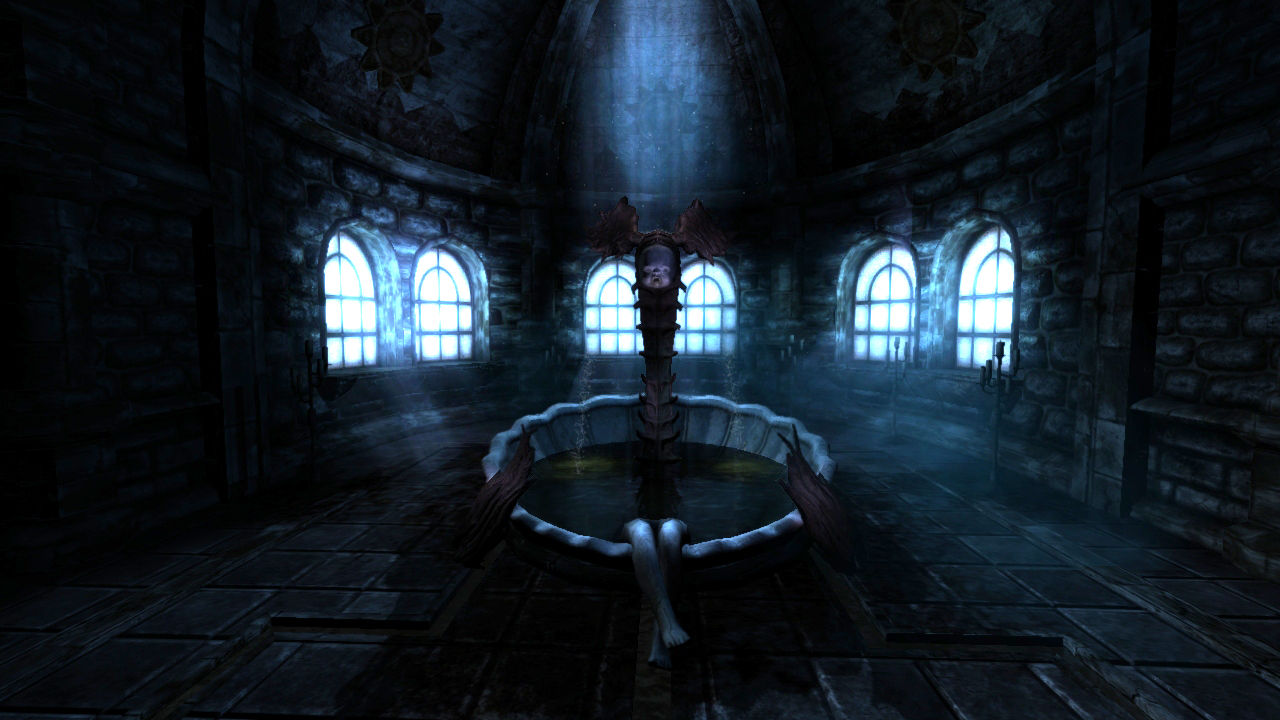
Before Amnesia, first-person horror games gave you guns. F.E.A.R. gave you guns. Condemned gave you improvised weapons. The horror was managed through your capacity to fight.
After Amnesia, a genre emerged built entirely around Frictional's specific design logic: no weapons, vulnerability as the primary emotional register, sound as the principal threat indicator, darkness as an active mechanical danger. Outlast. Layers of Fear. Little Nightmares. SOMA. Signalis. Darkwood. Each traces its DNA directly back to decisions Frictional made in 2010.
None of them have quite matched the original, and I think there are two reasons for this. First, Amnesia's power derives partly from novelty. The specific shock of realising you have no weapons, in a first-person game, is an experience that cannot be replicated for audiences already familiar with the genre it created. Second, Frictional got the design genuinely right in ways that are very difficult to follow. The sanity mechanic is the most elegant mechanical representation of psychological deterioration in the medium. Brennenburg Castle is among the finest horror environments ever built. Combining both in the same game, at the budget they were working with, in 2010, is the kind of creative achievement that is easier to appreciate in retrospect than it was to recognise at the time.
The studios that followed Amnesia have, almost universally, understood the surface features (no weapons, first-person, darkness) without fully understanding what those features were doing mechanically. No weapons is not the design. No weapons is a consequence of the design, which is: make the player feel genuinely and continuously vulnerable, and give that vulnerability mechanical weight rather than just narrative framing. Most games that say "no weapons" without building the vulnerability system Frictional built produce experiences that feel like Amnesia but do not produce the specific quality of fear that Amnesia produces.
The sanity mechanic specifically is worth naming as the most underappreciated design element in the game. It is not just a penalty for looking at monsters. It is a system that makes the player complicit in their own experience of horror. You make choices about what to look at, how long to stay in darkness, how much of your sanity to spend on gaining information about what is threatening you. The management of sanity is not a resource minigame. It is a psychologically coherent representation of what sustained horror does to a person, made playable. Nothing since has engaged with this specific design territory at the same level.
The game is $9.99. It has been on sale for $0.99. For what it delivers, the price-to-impact ratio is essentially without parallel in the medium. Buy it. Play it with good headphones. Come back and tell me I was wrong about it.
Amnesia still works in 2026. Fourteen years later, in a genre with hundreds of descendants and imitators, it still produces the specific quality of sustained psychological fear that nothing else has matched. $9.99, frequently under $3. That is genuinely infuriating value for what it delivers, in the sense that a game this effective at its core purpose being available for under a cup of coffee makes every $70 AAA horror game that failed to achieve the same thing feel even worse by comparison. There is no excuse for not having played it.
Amnesia: The Dark Descent is available on PC. $9.99, frequently under $3 on sale. Play it with headphones. Dark room. Do not look up what happens. Do not say you were not warned. You were.
Buy on Steam | Frictional Games
Game at a glance
| Detail | Answer |
|---|---|
| Genre | Survival Horror |
| Typical length | 6-9 hrs |
| Difficulty | Moderate |
| Play mode | Single player |
| Developer | Frictional Games |