Darkest Dungeon's Stress Mechanic Changed How Horror Games Work and Nobody Gave It Enough Credit
Red Hook Studios built a roguelike in 2016 that understood something most horror games still don't: the scariest thing is not the monster in the room. It's watching your own people break.

TL;DR
- The stress mechanic -- a second bar alongside health that breaks heroes psychologically -- is the most mechanically original horror idea in the genre.
- Eight years and dozens of games have cited it as an influence. None have actually replicated what it does.
- $10.99. Hundreds of hours of genuine content.
Buy it. $10.99 on Steam. One of the most mechanically original horror games ever made, and the stress system alone justifies the price of entry several times over.
Darkest Dungeon came out in Early Access in 2015 and full release in 2016. Red Hook Studios built a turn-based dungeon crawler with a mechanic that no other horror game had seriously attempted before and none has genuinely replicated since: your heroes can break. Not die. Break.
I want to be specific about the distinction. Watching a hero die in most RPGs is a resource loss. Something you invested in is gone. Watching a hero break in Darkest Dungeon is something different. It is watching someone you have invested time and genuine concern in become a different, worse version of themselves. And knowing that you are responsible for putting them in a situation that did that.
The game cost $10.99. It produced that experience. I have paid more for games that could not come close to doing anything similar. The budget and the team size are almost irrelevant to what Darkest Dungeon accomplished, because what it accomplished is rooted in a specific design insight that money cannot buy and committee approval processes tend to kill. Red Hook had the insight and the independence to execute it without someone asking whether the affliction system would test well with mainstream audiences. That kind of question, asked by a publisher at the wrong moment, kills more interesting design than anything else in the industry. It is genuinely infuriating how much good work never gets made because someone in a meeting decided it was too weird.
The Stress Mechanic
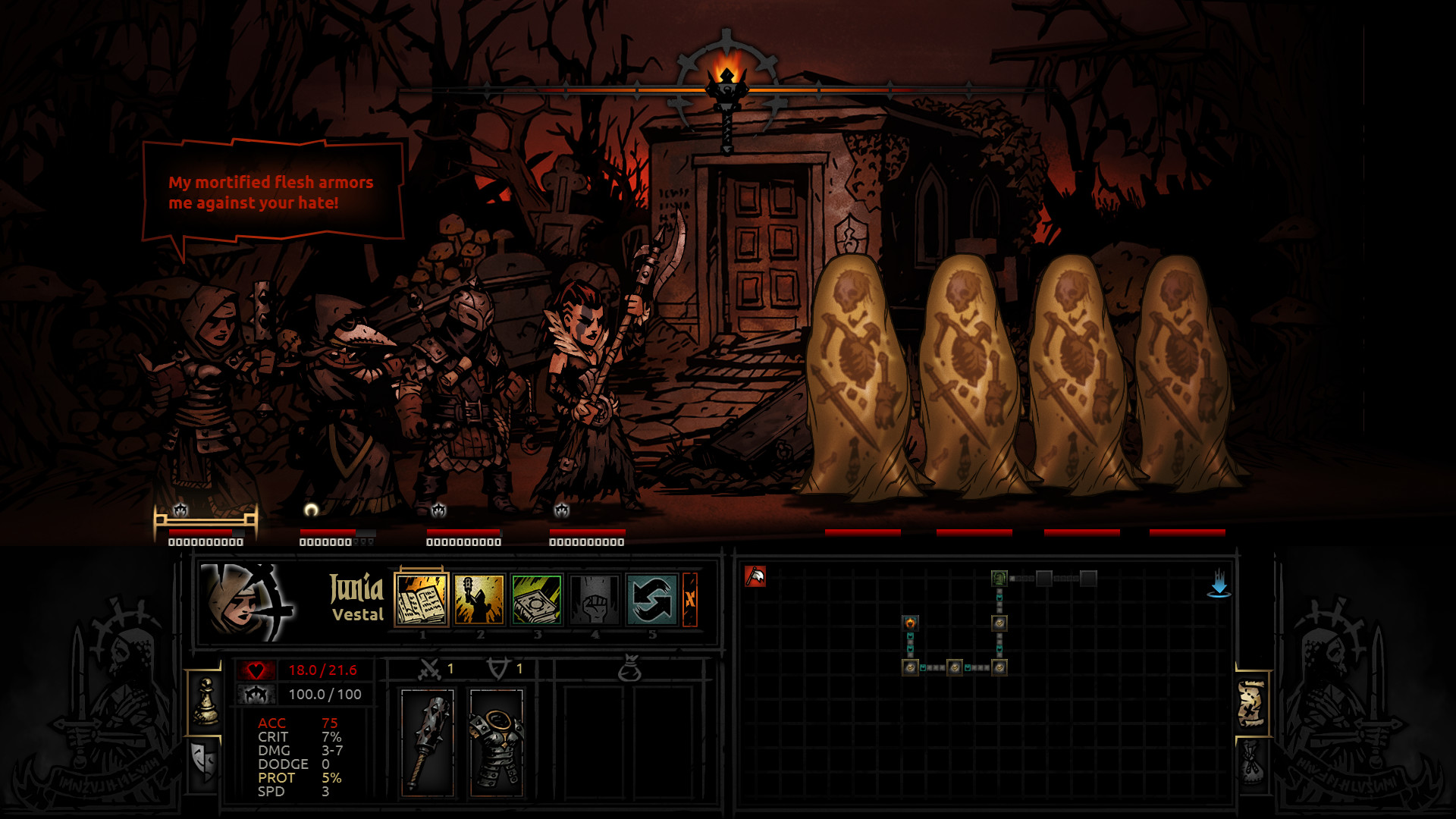
Every hero in your party has two bars: hit points and stress. Combat damages hit points. Everything else damages stress: darkness, dead bodies, eldritch imagery, the screaming of an afflicted teammate, failed skill checks, traps, certain monster abilities. The dungeon is a relentless stress environment and recovery is expensive.
When stress hits 100, your hero has an affliction event. This is where the design reveals itself fully, because the affliction is not a flat mechanical penalty. It changes who the hero is.
A hero might become Abusive, lashing out at teammates with comments that damage their resolve in turn. Or Masochistic, refusing heals, requiring their hit points to be dangerously low before accepting treatment. Or Paranoid, skipping turns or acting on perceived threats that may not exist. Or Hopeless, with a random chance each turn of simply failing to act at all.
Or, occasionally, they become Virtuous: steeling themselves under pressure, gaining bonuses, becoming a source of stability rather than a drain on the party. The heroic response is real and it exists. It is rarer than the afflictions. That proportion is exactly correct.
If stress reaches 200, the hero has a heart attack. They can die from accumulated stress alone, regardless of their current hit points.
This is horror design. Not horror as jump scare or atmospheric tension but horror as the observable psychological deterioration of people you are responsible for. I have not found anything in the genre that replicates this specific feeling. The closest analogue is something like a war film where the human cost accumulates over time and only lands fully because you watched it build. Darkest Dungeon does it through dungeon crawler mechanics, which is a remarkable creative achievement.
Why This Works When Jump Scares Do Not
Most horror games operate on a simple model: create something frightening, present it to the player, generate a reaction. The reaction is immediate and physiological. Heart rate spikes. Adrenaline arrives. Two seconds later the person is laughing or swearing at their screen.
What this model cannot produce is sustained dread. The specific feeling that something bad is going to happen and you cannot stop it and it will matter when it does. That feeling requires investment. You have to care about the outcome before the outcome matters.
Darkest Dungeon creates investment through its hero management system. By the time a hero dies of accumulated stress or breaks irreversibly under an affliction, you have taken them through multiple dungeons. You have watched their quirks develop. You know their name. You made the decision to bring them into the dungeon where this happened.
The horror is personal because the relationship is personal. When a hero breaks in ways that start hurting the rest of your party, you feel responsible in a way that no jump scare can produce. A jump scare happens to you. A broken hero happens partly because of you. That is a fundamentally different emotional register, and the one that produces the experience that stays with you long after the session ends.
I think about specific Darkest Dungeon moments years after playing them. A highwayman called Dismas who survived four near-death experiences, developed an addiction to laudanum, and died in the Weald when his affliction triggered at the worst possible moment and he refused a heal. I was annoyed with myself about how much I cared. The game produced that emotional response entirely through systems, without a single line of authored story content for that specific character. That is the kind of design work that is easy to describe and very difficult to execute.
The Emergent History System
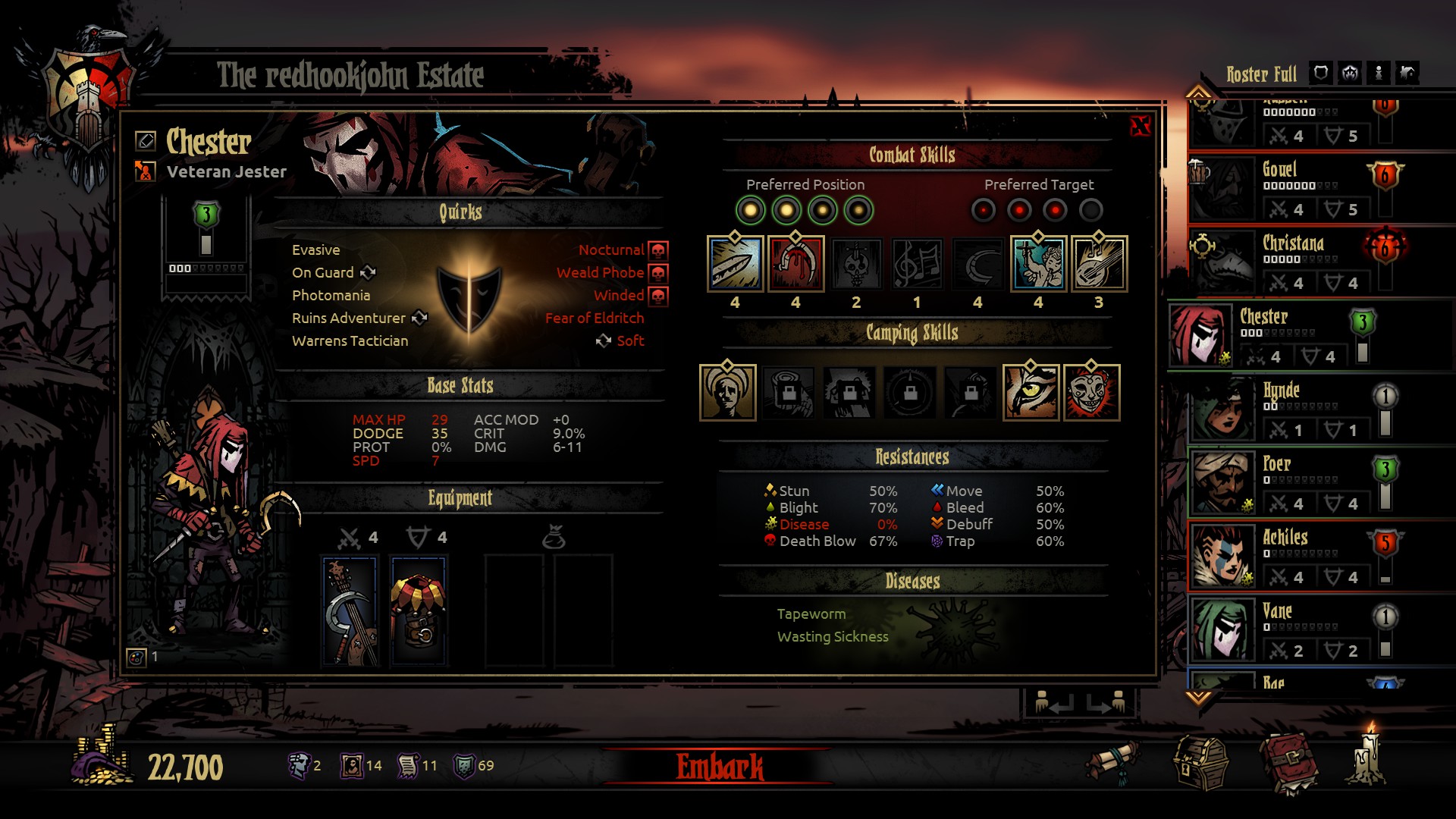
Most RPGs give you a fixed party. Your characters are yours and you invest in them specifically. Darkest Dungeon has a roster: a constantly replenished pool of heroes cycling through your hamlet, each generated with names and accumulating histories through play.
Heroes develop permanent quirks from their experiences. A hero who barely survived a particularly brutal expedition might have developed a phobia of the region where it happened. One who has been near death repeatedly might have a nervous condition. These quirks are permanent unless you spend scarce resources to treat them at the sanitarium.
The hamlet management layer above the dungeons reinforces all of this. Your hamlet develops over time as you spend gold on upgrades: the stagecoach that brings more heroes, the sanitarium that treats afflictions, the pub that provides stress relief but introduces its own risks. These systems are in constant resource tension that forces decisions you will regret in specific ways. The regret is correct. This is a game about things being irreversibly worse than you hoped, and the design never lets you forget that.
Over extended campaigns, individual heroes develop histories that are entirely emergent. You did not write them. The systems generated them from your choices and a degree of random variance. But they feel authored because they feel specific to your experience. Nobody else had exactly your Dismas. The game gave him to you specifically through the particular sequence of dungeons you ran and decisions you made.
Wayne June
The narration deserves a section by itself, because it is doing more structural work than it initially appears to be.
Wayne June voices the narrator, a disembodied presence commenting on every event in language drawn from Victorian Gothic literature. "Torchlight pushed back the oppressive dark" is not functional game text. It is register calibration: the sentence tells you what kind of story you are in, what the tone is, what the thematic vocabulary is. The narration frames the stress mechanic as tragedy rather than as mechanics, which is the distinction between a horror experience and a horror game.
June's vocal quality is specifically calibrated for resignation rather than triumph. The narrator is not impressed by your victories. He has seen this before. He knows approximately how it ends. This quality, of someone who has witnessed this cycle and expects nothing good from it, adds a layer of dread that no visual element could produce on its own.
The specific lines June delivers at critical moments deserve attention. When a hero dies, when an affliction triggers, when the party retreats in failure, there are lines that feel earned rather than atmospheric. "The price of failure in the dungeon is always blood." These are not just gothic flavour. They are restatements of the game's central argument delivered at the moment when the player is most likely to feel its weight.
I have heard these lines hundreds of times across multiple campaigns. They do not become meaningless through repetition in the way most incidental dialogue does. They become more resonant, because by the time you have played enough to hear them repeatedly, you understand exactly what they are describing from personal experience. The narrator is not commenting on the action. He is narrating a pattern he has observed before. He was there before your heroes arrived and he will be there after they are gone. That persistence, that sense of being a small and temporary part of something that has been grinding people down for a very long time, is a tonal achievement that elevates every other element of the design.
What Red Hook Got Right That Everyone Else Missed
Darkest Dungeon was released in 2016. In the eight years since, dozens of horror games have cited it as an influence. None have replicated the stress mechanic in ways that produce the same experience.
The mechanic itself is not complicated to describe. Heroes have a stress bar. High stress causes afflictions that change behaviour. The behaviour changes affect other party members. The whole thing escalates. This is not a design secret. It is clearly documented and widely discussed.
What has not been replicated is the specific emotional effect, and I think the reason is that the stress mechanic only works because of everything surrounding it. The Gothic aesthetic that frames stress as something the human mind genuinely cannot withstand. The narrator's voice establishing that psychological damage is permanent and meaningful. The hamlet management system that gives you an ongoing relationship with a pool of heroes rather than a fixed party. The permadeath that makes the afflictions matter at all.
Games that have borrowed the stress mechanic without the surrounding context produce something that feels like a mechanical curiosity rather than a horror experience. The stress bar does not generate dread by existing. It generates dread because the player already understands that what happens when it fills is genuinely bad, that the badness will persist, and that it happened partly because of choices they made. Take away the permanence, or the player's sense of responsibility, or the Gothic framing that makes psychological deterioration feel inevitable, and you have a different game.
Red Hook understood, consciously or intuitively, that the stress mechanic was not the design. It was the centrepiece of a design in which every other element was chosen to make it land correctly. That is the thing that cannot be borrowed without the context. That is also why Darkest Dungeon 2, which I think is a good game, does not produce the same experience: the single-run roguelite structure removes the accumulated personal history that made the original's afflictions feel personal. It is a legitimate design choice and a fundamentally different emotional proposition.
One Honest Criticism
Darkest Dungeon can be genuinely unfair in ways that feel arbitrary rather than instructive. There are sessions where multiple affliction events trigger simultaneously and the cascade becomes unmanageable through no identifiable strategic failure. The RNG can construct runs where everything goes wrong simultaneously in ways that feel like the game is punishing you for nothing specific you did.
I have put the game down for weeks at a time after sessions like this. Not because the design is wrong. The chaos is part of what the game is communicating about what dungeons do to people. But successfully communicating the weight of the dungeon sometimes means making you feel genuinely beaten with no clear lesson to take from it.
Some players will find this more frustrating than engaging, and that response is legitimate. If you go in expecting a fair game you will be disappointed. Go in expecting a game about things being unfair and you will find it honest. The stress mechanic is not a difficulty setting. It is an argument about what dungeons do to people over time, and the argument is not comfortable, and it is not supposed to be.
The moments when it works are extraordinary. A hero breaking heroically rather than afflicting at the critical juncture. The right party surviving a dungeon everyone expected to fail. These moments feel earned in a way very few games produce, precisely because you know how badly it could have gone.
Darkest Dungeon is available on PC, PS4, Switch, and mobile. $10.99. The stress mechanic is the most original horror design the genre has produced. Nothing has replicated it adequately in eight years of attempts.
Buy on Steam | Red Hook Studios | Darkest Dungeon 2
Game at a glance
| Detail | Answer |
|---|---|
| Genre | Turn-Based Roguelike RPG |
| Typical length | 40-80 hrs |
| Difficulty | Hard |
| Play mode | Single player |
| Developer | Red Hook Studios |