Disco Elysium Is the Only RPG That Treats Players Like Adults and the Industry Hasn't Learned a Thing
Disco Elysium lets you fail to the truth, play a fascist, drink into a coma. The only RPG that trusts players to make genuinely bad decisions.

TL;DR
- Zero combat. 24 internal skill voices argue with you. Every conversation can be failed without ending the game.
- You can play a fascist. You can fail to the truth. Nothing else in the genre trusts players this way.
- $39.99, frequently on sale for under $10.
I played Disco Elysium in 2019 and it ruined other RPGs for me in the specific way that a genuinely good meal ruins the memory of the acceptable meals you were previously satisfied with. Not dramatically. Just with a persistent awareness of the gap.
Six years have passed. Nothing has followed it. Not in any meaningful sense.
Baldur's Gate 3 is the closest thing and it is a fundamentally different game: mechanically brilliant, narratively conventional in its structure, designed to be broadly satisfying to the widest possible audience. It is exceptional. What it does is not what Disco Elysium does, and those are different things. Comparing them is like comparing a brilliant Hollywood thriller to a literary novel. Both are excellent. Only one is trying to do something that cannot be replicated by a different approach.
I want to try to be specific about what Disco Elysium does that nothing else does, and why the gap remains six years later.
What You Are Actually Playing
You are Harry Du Bois. You are a detective who has drunk himself into amnesia. You wake up in a hostel room in the fictional city of Revachol Martinaise having apparently destroyed much of it. You are investigating a hanging body in the back yard. You do not remember who you are, what you believe, where you come from, or how any of this happened.
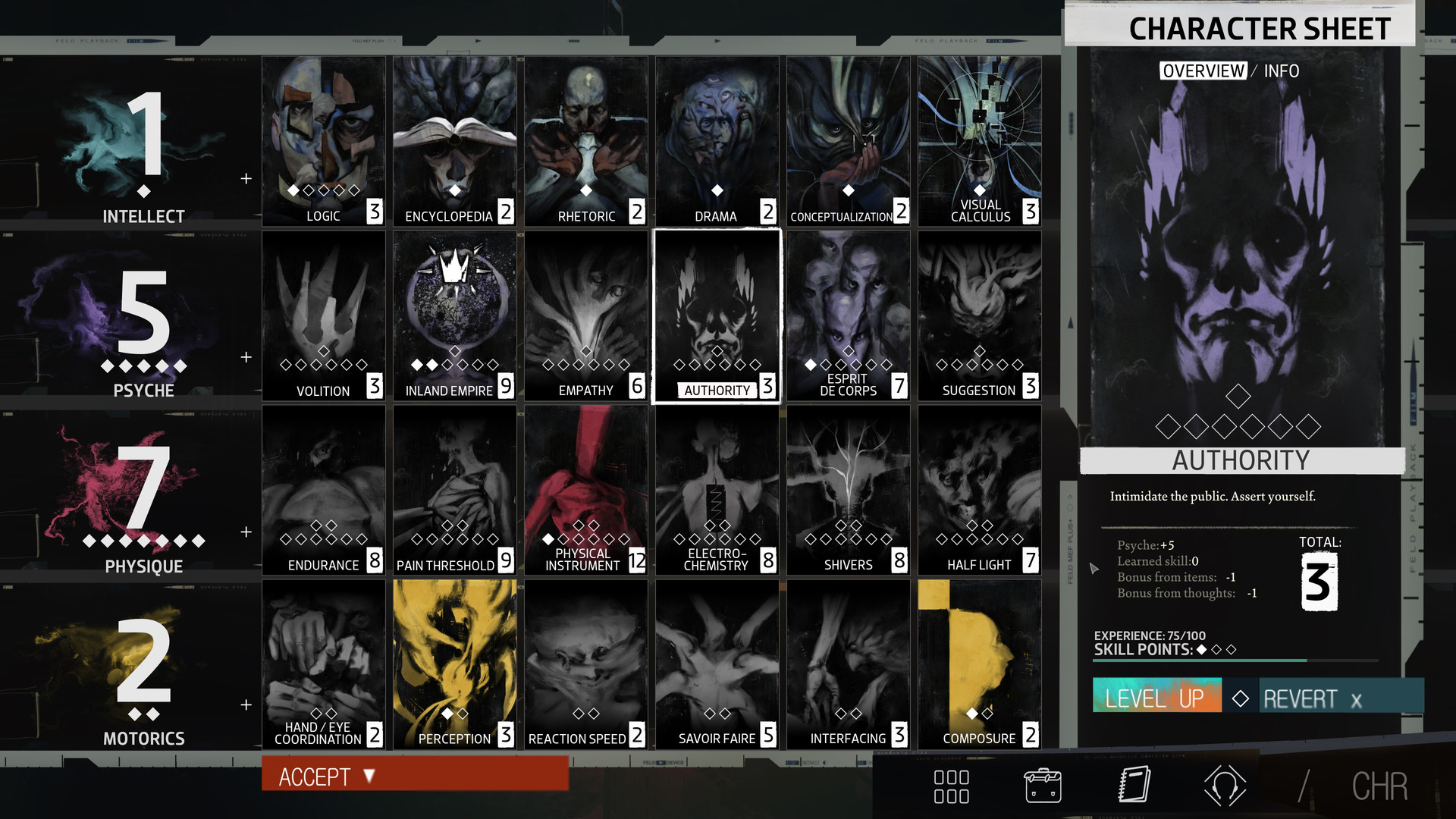
Your character is defined by 24 skills, each of which has a distinct voice and an active role in Harry's internal monologue. Electrochemistry wants you to consume substances and pursue pleasure. Inland Empire generates surrealist visions and offers interpretations of them. Shivers allows you to feel the history of the city through its climate. Empathy tells you what other people are feeling beneath what they say. These are not passive statistical modifiers. They are active participants in the conversation happening inside Harry's head, and they do not always agree.
The game has almost no combat. You investigate by talking to people, reading documents, failing skill checks and learning from the failure, and gradually assembling an understanding of both the murder and of who Harry actually is. There are no quest markers pointing you at the next conversation. The game assumes you are capable of finding out what needs to be found out without being guided to it. That assumption alone places it outside the mainstream of RPG design.
Why the Skill System Is Not a Skill System
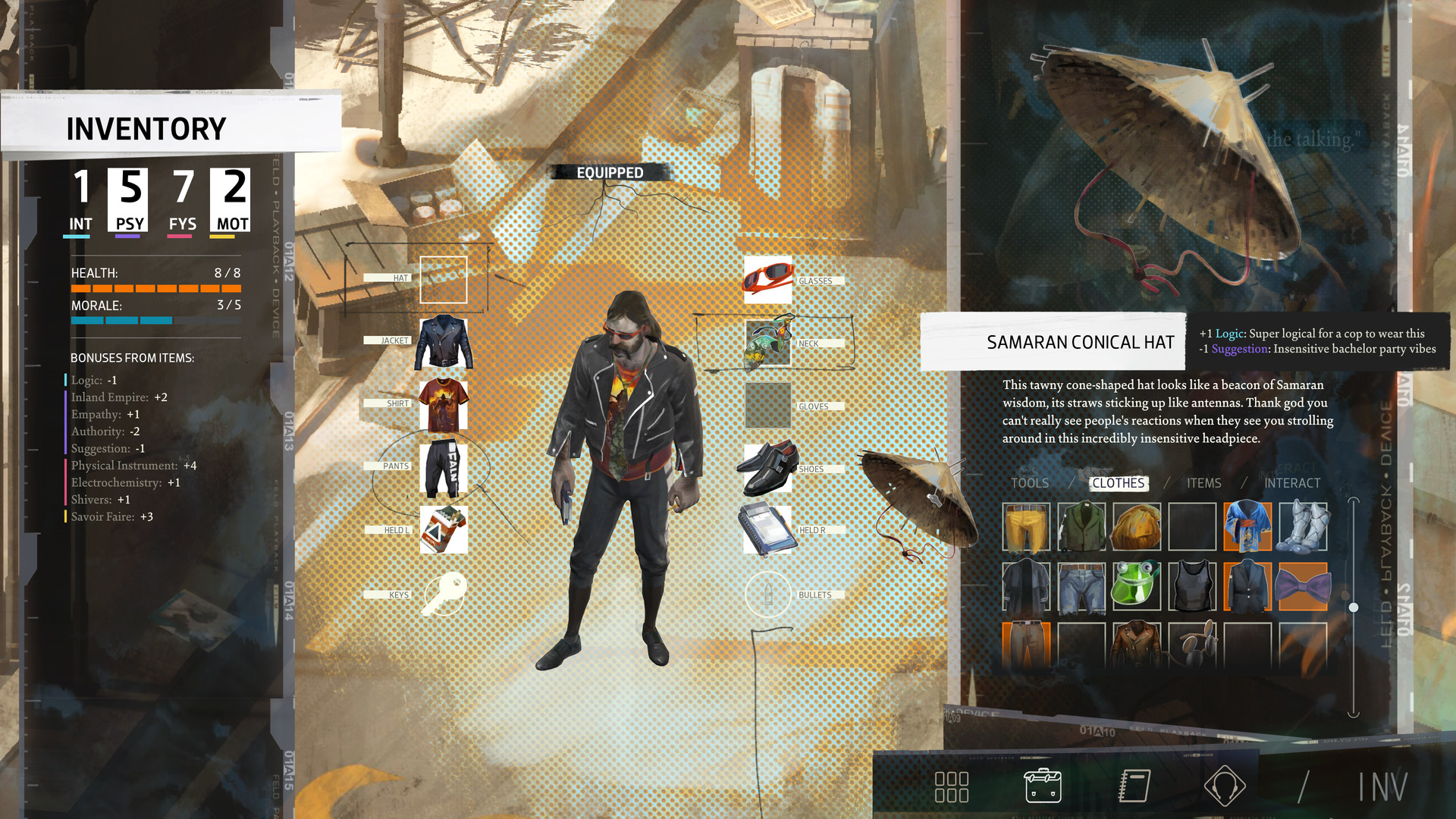
In a conventional RPG, skills modify dice rolls. The system is a mathematical layer on top of the narrative. It determines the probability of success but does not change the nature of the experience.
In Disco Elysium, the skills are characters. Investing heavily in Inland Empire does not just improve your chances on relevant checks. It gives you more of a specific psychological experience: more surrealist intrusion into Harry's perception, a particular way of encountering events that other skill configurations do not access. A Harry with maxed Inland Empire and minimal Logic encounters the same events as a Logic-heavy Harry and understands them differently in ways that are not just flavour text. They are different games.
Building Harry toward a specific skill emphasis is building him toward a specific psychology and a specific subjective experience of the investigation. Two playthroughs with different skill distributions are genuinely different games, not just different success rates on the same set of events.
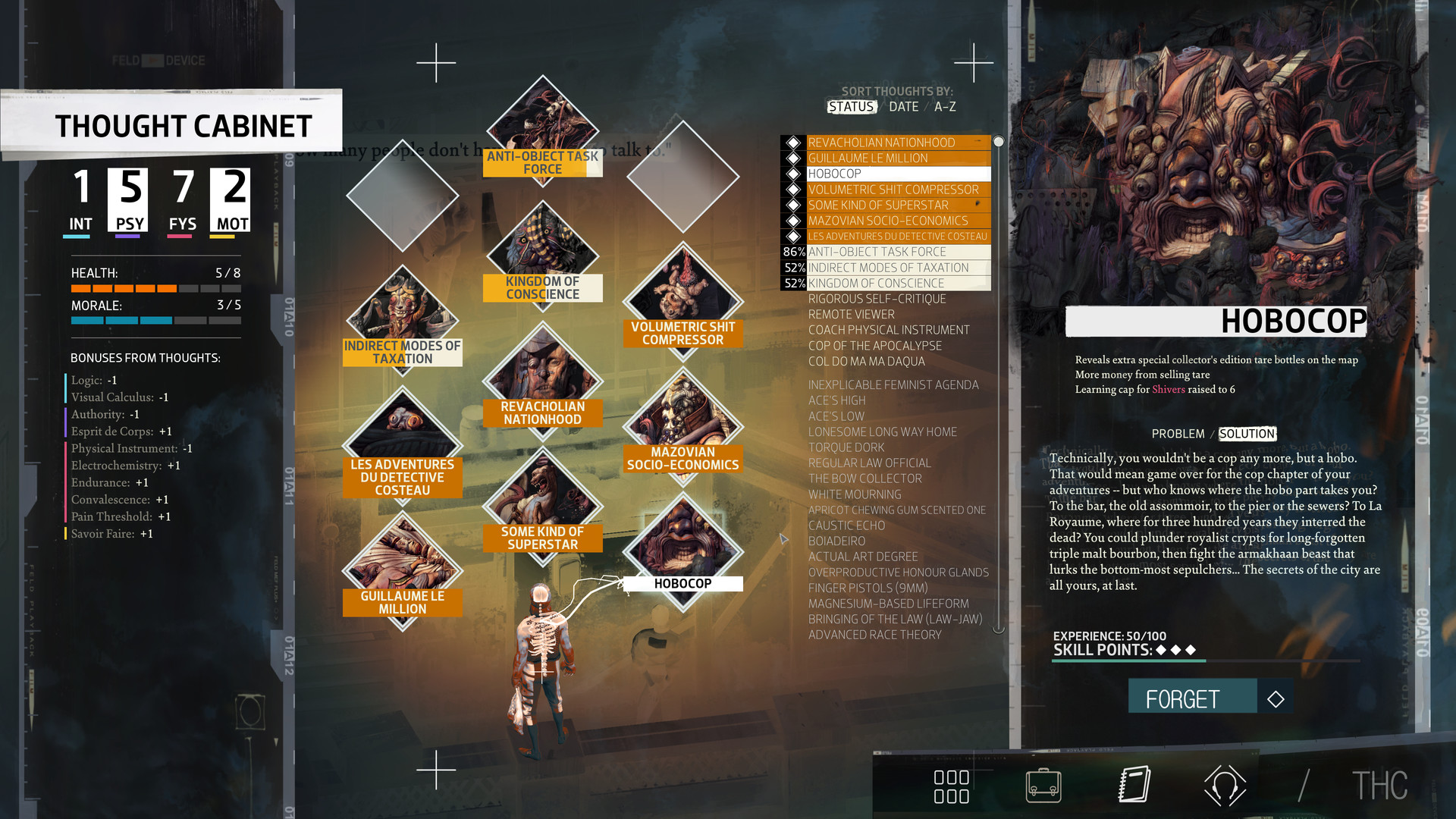
This is the design insight that makes Disco Elysium exceptional and unreplicable without the same level of writing investment. The mechanics and the phenomenology of play are unified. The character system is not a layer on top of the story. It is the story. The way Harry experiences the world is determined by what you invest in, and that experience is the game. To replicate this, you would need to write tens of thousands of lines of skill-specific dialogue with enough specificity that the skill's perspective genuinely changes the meaning of what is encountered, not just the probability of succeeding at it. That is an enormous writing investment that produces results that cannot be easily communicated in a pitch meeting. It is exactly the kind of thing that does not get funded.
Revachol Is a Real Place
The world-building in Disco Elysium deserves specific attention because it is doing something unusual: it is building a fictional city that feels like it has a history independent of the story being told in it.
Revachol is a city in the aftermath of a failed communist revolution, occupied by a supranational coalition government that neither loves nor hates it but simply manages it as a problem. The Martinaise district where the game is set is the waterfront, a specific neighbourhood with its own economy, its own politics, its own characters who have been living there before Harry arrived and will continue living there after he leaves. The game does not tell you this directly. You piece it together from conversations, from documents, from what the buildings look like and what their state communicates about what happened to them.
I found myself genuinely interested in Revachol as a place in a way I have not been interested in a game world since very few games I can name. Not interested in the story set there. Interested in the place itself. What it was. What happened to it. What the people who live there think of their situation.
This quality is almost impossible to manufacture. It requires writers who are genuinely interested in the political and historical questions the setting embodies, not as backdrop for the story, but as the subject of genuine intellectual curiosity. The Martinaise waterfront is a meditation on what failure looks like when the dust settles and everyone still has to live somewhere. That meditation required writers who cared enough about those questions to spend years building a city that embodies them. The result is a fictional city that feels real in the specific sense that it seems to exist independently of whether you are there to observe it.
The Political Writing
Disco Elysium contains the most sophisticated political writing the medium has produced. I am aware this is a strong claim and I am making it deliberately.
You can build Harry as a communist, a fascist, a moralist, or an ultraliberal. Each gives you access to distinct dialogue, distinct skill checks, and distinct interpretive frameworks for events. The game does not tell you which is correct. It shows you what each worldview looks like from the inside, with genuine care for the internal logic of each position, including positions the writers presumably disagree with, and what the world around Harry makes of someone who holds it.
The communist questline is not written to validate communism. The fascist questline is not written to validate fascism. Both are written to show you what these positions mean for a specific person in a specific failing city, with consequences that follow from the internal logic of each worldview rather than from external moral grading. The game trusts you to engage with this without being guided toward a conclusion.
This is what adult writing means. Not adult as a synonym for explicit content. Adult as in: it refuses to simplify contested questions into neat answers. The RPG genre has been technically capable of this since Planescape: Torment in 1999. Almost nothing in the twenty-six years since has tried as hard, and nothing since Disco Elysium has succeeded as well. The industry looked at what ZA/UM built and saw a critical darling that sold modestly. It did not see a model for what RPG writing could be. That tells you something genuinely depressing about what the industry optimises for.
Harry Du Bois as a Character
I want to spend a paragraph on Harry specifically because the design decision to make him the protagonist is one of the most audacious in the history of RPGs, and it does not get enough credit as a design decision rather than a writing choice.
Most RPG protagonists are either blank slates into which the player projects themselves, or defined heroes with established personalities who the player controls. Harry is neither. He is a specific, deeply flawed person with an extensive history that the player gradually uncovers, and the experience of playing him is the experience of discovering who you were before you ruined yourself.
The amnesia framing is not a narrative convenience. It is the design mechanism through which the game makes you simultaneously the character and the investigator of the character. You are playing Harry and you are learning about Harry. You are making decisions as Harry and watching what those decisions reveal about who Harry was and who Harry might become. The skill system amplifies this: the version of Harry you build through skill investment is the version of Harry who most closely matches your own interests and orientations, which means you are constructing a version of this broken person that is most like you, and then watching what that person does in Revachol.
This creates a specific kind of identification and a specific kind of distance simultaneously. You are Harry, making his choices, speaking his lines. You are also observing Harry, understanding him, and developing a relationship with him that is different from simple identification. By the end of the game, I found that I understood Harry Du Bois in a way that I understand very few fictional characters, including characters from prose fiction that had hundreds more pages to develop. That depth came from the particular way the game's mechanics and narrative are unified. It could not have come from a different design.
Why Nothing Has Followed It
The honest reason nothing has followed Disco Elysium is that the conditions that produced it were specific and are difficult to reproduce.
ZA/UM was founded by Robert Kurvitz and others who had been working on the Elysium setting for years before the game existed. The world had been developed in tabletop campaigns. The political philosophy had been argued out. The specific voice and the specific interest in the questions Revachol embodies came from real intellectual investment by specific people over a long time before a single line of game dialogue was written. The game that emerged is the output of that investment, and you cannot commission investment of that kind. You can fund it, given the right people and the right conditions. You cannot purchase it on a schedule.
The studios that have attempted Disco Elysium-adjacent games in the years since have produced things that look similar on paper: heavy dialogue, skill-based exploration, political themes, unusual settings. None of them have produced the specific quality of intellectual engagement that Disco Elysium produces, because the quality comes from the people who made it having genuinely thought through the things they were writing about rather than having been tasked with writing a certain kind of game.
This is, for the record, very much not a criticism of the studios that have tried. Making something like Disco Elysium requires the thing that produced Disco Elysium, and that thing is not replicable on demand. It is the output of specific people with specific obsessions working in specific conditions over a long time. The genre cannot produce a follow-up on a development schedule. The follow-up will arrive when the right people have spent long enough with the right questions to have something genuinely worth saying.
There is also a structural reason the industry does not produce this kind of game at scale, and it is worth naming plainly. Disco Elysium does not have clearly telegraphed quest objectives. It has no minimap marking the next location. It fails you on skill checks and expects you to learn from the failure rather than retry until you succeed. It has a protagonist who is, in many readings, an irredeemable mess. The political content is genuinely contested rather than resolved in favour of whatever the player is likely to already believe. These are not properties that test well with general audiences. They are exactly the properties that make the game what it is.
A publisher evaluating Disco Elysium as a pitch would have changed most of these things. The developer who made it did not have a publisher with that kind of influence during the critical creative development period. The game that exists is the game that was made without those interventions. Understanding that is understanding why the industry has not followed it: the properties that make it exceptional are the same properties that would have been removed in a conventional publishing relationship.
The games that follow Disco Elysium in the meaningful sense will be made by people who have spent years with their own specific obsessions, in conditions that protect those obsessions from being smoothed out by commercial pressure. They will arrive without warning, be critically celebrated, and be commercially modest. And the industry will look at those numbers and draw the wrong lesson, again, exactly as it drew the wrong lesson from Disco Elysium's commercial performance in 2019.
The ZA/UM Situation and What It Means for the Future
The people who made Disco Elysium were removed from the company they founded. Robert Kurvitz, Aleksander Rostov, Argo Tuulik, the primary creative figures, were pushed out of ZA/UM in 2022. The specific circumstances are legally contested. The outcome is not: the writers and designers who built the game are gone.
A sequel has been announced. It will be made without them.
I have thought carefully about how to assess the sequel's prospects and I cannot reach optimism. The creative vision that produced Disco Elysium was specific to the people who held it. Those people are no longer at the company. Whether what emerges without them is meaningfully connected to what Disco Elysium was is an open question, and the prior for the answer being yes is not high.
The game itself is intact and available. Play it before the sequel reshapes the cultural conversation about what it was. Play it without looking anything up. Let it do what it does without foreknowledge.
I have played it twice. Each playthrough revealed things I missed. I will play it again. It is one of the most significant things the medium has produced and the industry has, as I said at the top, learned nothing from it. That is genuinely infuriating, and I think it will remain infuriating for a long time.
Disco Elysium: The Final Cut is available on PC. $39.99, regularly on sale for under $10. The best writing the medium has produced. Play it.
Buy on Steam | ZA/UM
Game at a glance
| Detail | Answer |
|---|---|
| Genre | RPG |
| Typical length | 20-30 hrs |
| Difficulty | Easy |
| Play mode | Single player |
| Developer | ZA/UM |