KARMA: The Dark World Is the Most Visually Stunning Horror Game I've Ever Played
Critics gave KARMA: The Dark World a 72 on Metacritic. They were wrong. Pollard Studio's first-person psychological thriller set in alternate 1984 East Germany is a genuinely extraordinary piece of work -- the most beautiful horror game I've played, with a story that earns every one of its surreal moments.

TL;DR
- 72 on Metacritic is a genuine undersell -- the most visually stunning horror game reviewed on this site.
- Built in Unreal Engine 5 with Lumen and Nanite, punching well above what the studio's size would suggest.
- $24.99. Minimal gameplay, cinematic and deliberate. Don't go in expecting mechanical challenge.
KARMA: The Dark World scored 72 on Metacritic. Critics called it "simplistic," said it "bluntly references" its influences without transcending them, that the gameplay was too passive, that the story was too abstract. I played it start to finish in one sitting and sat staring at the credits with that specific kind of stillness a piece of art leaves you with when it's done something to you.
The critics weren't entirely wrong, and I want to be clear about that upfront. KARMA is not a perfect game. The gameplay is minimal. There are moments where the symbolism announces itself more loudly than it needs to. If you go in expecting action, you'll be bored inside twenty minutes. That's not a flaw. It's a genre question.
But a 72 is a catastrophic misread of what this game actually is and what it actually does. KARMA: The Dark World is the most visually stunning horror game I have ever played. The story it tells, inside a world it builds with extraordinary care, is one that stayed with me for days after I finished it. Some games you complete. Some games complete you, and the second kind are the ones worth talking about. KARMA is the second kind.
This review is going to be long. The game deserves it.
The World

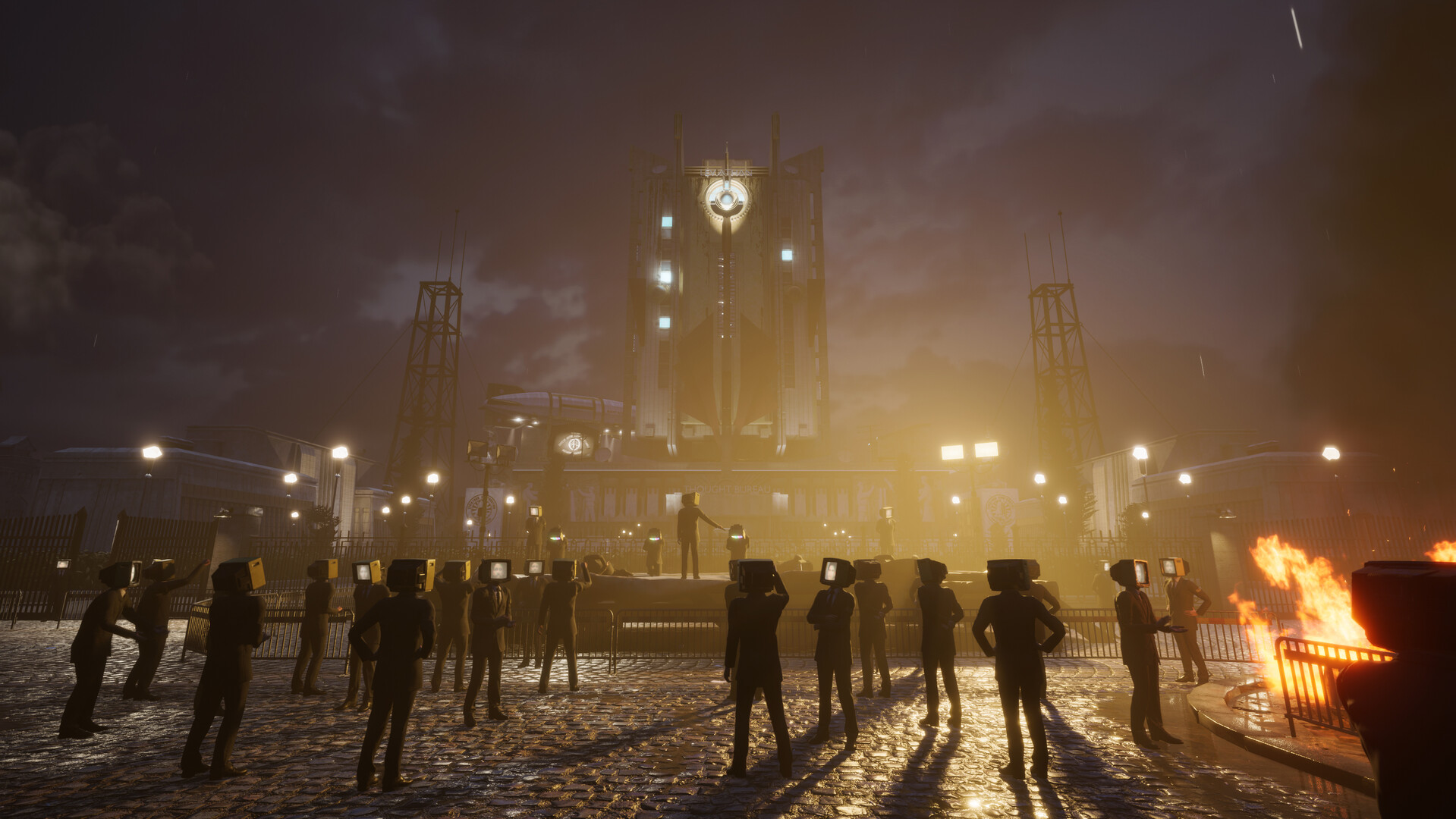
You play as Daniel McGovern, a Roam Agent for Leviathan Corporation's Thought Bureau. The year is 1984. The place is East Germany, but not the East Germany of our timeline. In this version of history, the Leviathan Corporation won. It rules through mass surveillance, class hierarchy, mind-altering drugs, and an AI named MOTHER who watches everything and everyone. Citizens are promised that if they serve Leviathan faithfully, the gates to Utopia will open. Nobody asks what happens to the ones who don't make it.
Your job as a Roam Agent is to dive into the minds of suspects. Using technology that the game explains just enough to be plausible and not so much that it breaks, you enter the mental space of the accused, walk through their memories, piece together what happened, and report back to Leviathan. You are, in essence, a thought policeman. The game is very clear about this. It does not let you forget what you are.
The influences are obvious and acknowledged. Orwell's 1984 is the structural scaffolding. Twin Peaks lives in the surreal logic of the dream sequences. Silent Hill haunts the monster design and the way psychological states become physical environments. Alan Wake is present in the way narrative and horror intertwine. Critics used the word "blunt" about these references, and I understand why, but I think they're wrong. KARMA doesn't pretend these influences don't exist. It wears them as context, as shared language with an audience that loves these things, and then builds something that feels genuinely its own inside that framework.
The world of Leviathan is the best argument for this. The Thought Bureau, the building you return to between mind-dives, is one of the most oppressively designed environments I've encountered in any horror game. The propaganda posters. The department names on the walls: Propaganda, Re-Education, Historical Revisionism. The stamping rooms where workers sit in rows for endless hours drinking Leviathan's company "energy drink" while a projector plays slogans at them. One scene that absolutely gutted me shows office workers reading an internal memo announcing that all breaks have been eliminated to "support company growth." It's played completely straight. That restraint makes it more horrifying than any monster the game throws at you.
The Visuals
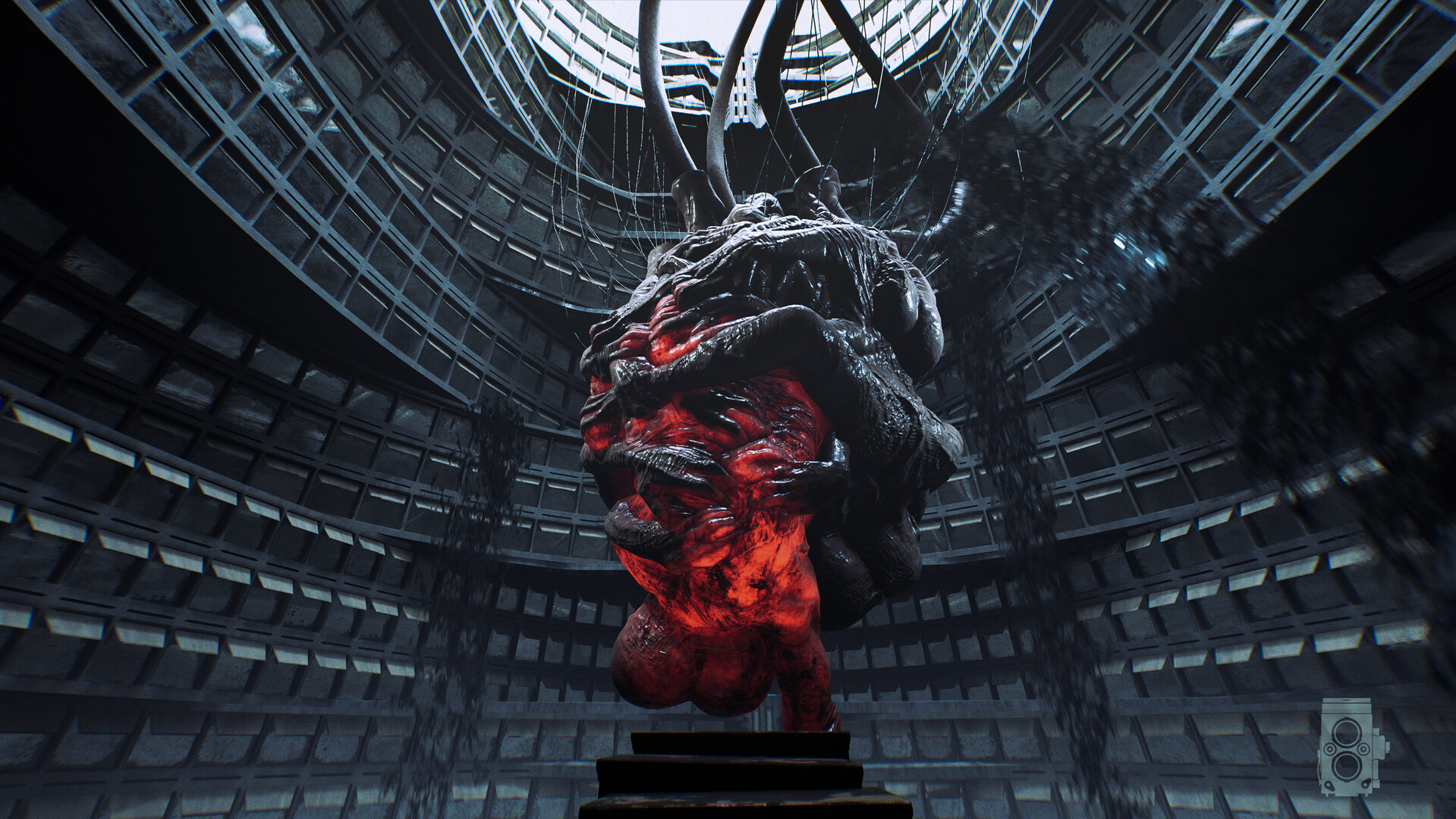
I need to spend time on the visuals because I don't think the reviews did them justice. KARMA is built in Unreal Engine 5 using Lumen for global illumination and Nanite for geometric detail, and Pollard Studio uses these tools with a level of artistry that most much larger studios haven't managed.
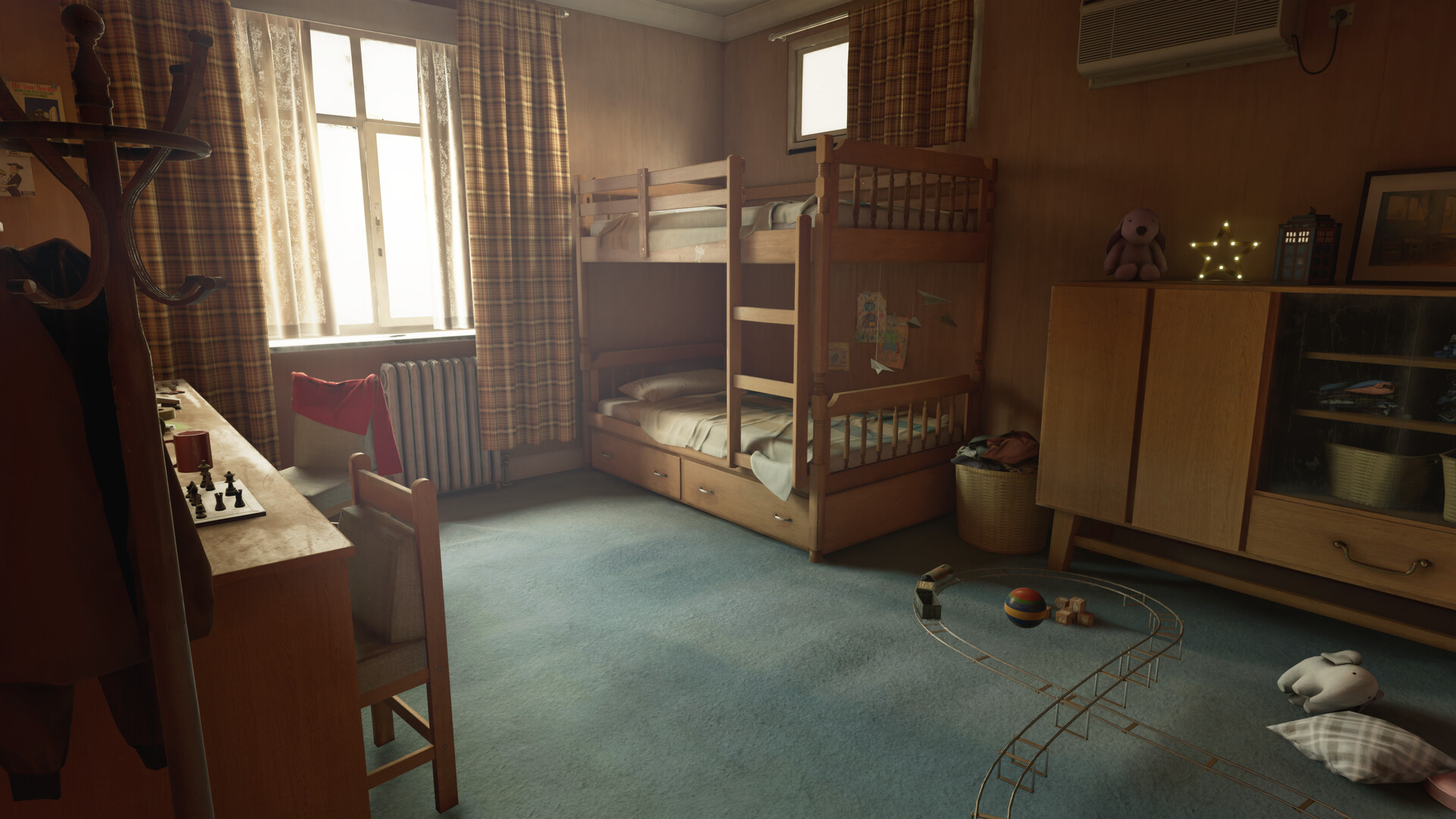
The real-world sections (the Thought Bureau, the streets of Leviathan's East Germany) have a weight and material authenticity that grounds you before the mind-dives pull the rug out. Stone feels like stone. Concrete feels like concrete. The colour palette is cold, institutional, deliberate. And then you dive into a suspect's mind and everything changes.
The mind-space environments are extraordinary. Moonlit beaches stretching to infinity beneath impossible skies. Corridors that breathe. Statues reaching upward through darkness as if trying to escape. Geometry that shifts and folds according to the emotional logic of the person whose memory you're inside. Horror that isn't blood and gore but wrongness: the specific texture of a space that obeys rules you don't quite understand.
The game runs on my RTX 2070 Super at 1440p with DLSS at a locked 60fps. It looks better than most games I've played on hardware twice as powerful. The Dolby Atmos audio mix compounds this. The soundtrack, a collaboration between the studio and external composers, combines orchestral score with original songs in a way that shouldn't work and absolutely does. There is a specific piece of music that plays during one of the late-game mind-dives that I genuinely could not tell you the name of but that I can still hear clearly in my head weeks later.
If you have a good audio setup or a quality pair of headphones, please use them for KARMA. This is one of the rare games where the audio is doing as much narrative and emotional work as the visuals.
The Story
I'm going to be careful here because KARMA's story is one that earns its revelations, and I want to give you enough to understand why it works without taking away what makes it land.
The structure is investigative. You receive cases. You dive into minds. You see what those people saw, felt, feared, desired. And slowly, across six or seven hours, the cases stop being about the suspects and start being about Daniel. About what Leviathan did to him. About what he did in service of Leviathan. About what memory is when a corporation controls the machines that read it.
The philosophical territory KARMA covers is genuinely ambitious. It asks questions about identity, complicity, the nature of consciousness, and what it means to be human inside a system designed to strip humanity away. It asks them through the specific, grounded horror of a totalitarian state rather than through abstraction, which is what separates it from games that gesture at these themes without earning them.
The ending. I'm not going to describe it. I'll say that the complaint you'll sometimes see in reviews, that the game's story is too complex, too abstract, hard to follow, comes from a reading of KARMA that treats opacity as failure. The ambiguity is deliberate. The questions the game leaves unanswered are the ones it wants you to carry with you. I found the ending completely satisfying precisely because it didn't resolve everything. It resolved the things that mattered and left you sitting with the things that should sit with you.
One ResetEra user described it as "one of the very few games that managed to hook me from the start by being intriguing, staying interesting throughout the middle and then absolutely landing the ending." That matches my experience precisely. KARMA is one of the few horror games in recent memory that sticks the landing.
The Criticisms (Which Are Real But Overweighted)
I want to be honest about the things KARMA does less well, because a review that ignores its weaknesses isn't useful.
The gameplay is minimal. You walk, you observe, you interact with objects, you solve puzzles. The chase sequences exist but they're scripted enough that tension is limited once you clock the pattern. If you play horror games primarily for mechanical challenge, KARMA is going to frustrate you. This is a cinematic experience in the fullest sense. It's closer to walking through a film than playing a traditional game.
The pacing in the final third slows down in a way that a few reviews identified and I agree with. After a mid-game sequence that is among the most intense pieces of horror I've experienced in any medium, the game takes its foot off the gas. It's a pacing decision that genuinely pissed me off on first playthrough, though it bothered me less on reflection. It recovers for the ending, but there's a stretch where the momentum lets up when you want it to press harder.
And yes, the influences are legible. If you've played Silent Hill 2, you will notice. If you've watched Twin Peaks, you will notice. The question is whether that legibility is a failure of imagination or a deliberate act of situating itself in a tradition. I believe it's the latter. Your mileage may vary.
None of these things substantially diminish what KARMA achieves. They're worth knowing. They're not worth letting them stop you from playing it.
The Verdict
KARMA: The Dark World is currently 45% off on Steam. At full price it's around $25. For six to seven hours of the most visually extraordinary horror I've played, a story that earns its ambition, and a soundtrack I'm still thinking about, that's one of the best value propositions in the genre right now.
The 72 Metacritic score is a data point about critic consensus, not about the experience the game delivers. Metacritic scores for horror games are frequently bloody useless for this exact reason. Horror is a genre where the personal response matters more than any aggregate score, and the gap between "72 on Metacritic" and "this genuinely moved me" is sometimes enormous. Signalis scored in the low 80s and became a cult classic because the people it hit, it hit completely. The aggregate score told you almost nothing about whether you specifically would love it. KARMA is that kind of game. It will not land for everyone, and that's fine. Some of the most important horror games ever made didn't land for everyone. For the people it does land for, it will land hard.
I'm Irish, I live in Johor Bahru, and I played a game about East German citizens living under totalitarian surveillance in an alternate 1984 and came away thinking about what it means to serve a system you know is wrong because the alternative is worse. That's what KARMA does when it's working at its best. It takes an abstract horror and makes it specific enough to feel personal.
Buy it. Use headphones. Don't look up the story before you play it. Give it the first hour before you decide whether it's for you.
It's for you.
KARMA: The Dark World on Steam -- $24.99 (currently 45% off)
Game at a glance
| Detail | Answer |
|---|---|
| Genre | Psychological Horror |
| Typical length | 6-7 hrs |
| Difficulty | Easy |
| Play mode | Single player |
| Developer | POLLARD STUDIO LLC |