Skull and Bones: $750 Million, Seven Years, and the Most Expensive Lesson in AAA Hubris
$750 million. Seven years. A 58 Metacritic. Skull and Bones is the most expensive lesson in what happens when no one is allowed to say no.

TL;DR
- $750 million, seven years, at least five creative pivots -- the most competently executed $750M game ever made, and that's not a compliment.
- Black Flag's naval combat, built in 2013 for a fraction of the cost, still outperforms this.
- 1 million copies sold in six weeks against a reported break-even target of 4-5 million.
I need you to sit with a specific number: $750 million. That is the reported development cost of Skull and Bones across seven years of development and at least five major creative overhauls. Seven hundred and fifty million dollars. Read it again.
The game reviewed at 63 on Metacritic. It sold approximately 1 million copies in its first six weeks against a break-even estimate of 4-5 million copies. Before launch, Ubisoft CEO Yves Guillemot described it in an interview as "quadruple-A," a term he invented for the occasion because no existing superlative was large enough to represent the cost.
I played several hours of Skull and Bones when it launched. The naval combat works. Ships move. Cannons fire. The world is sometimes visually striking. It is the most competently executed $750M game I have encountered in my years of playing games. That description is not a compliment. It is the most damning thing I can think of to say about it.
How a Game Costs $750M and Plays Like $30
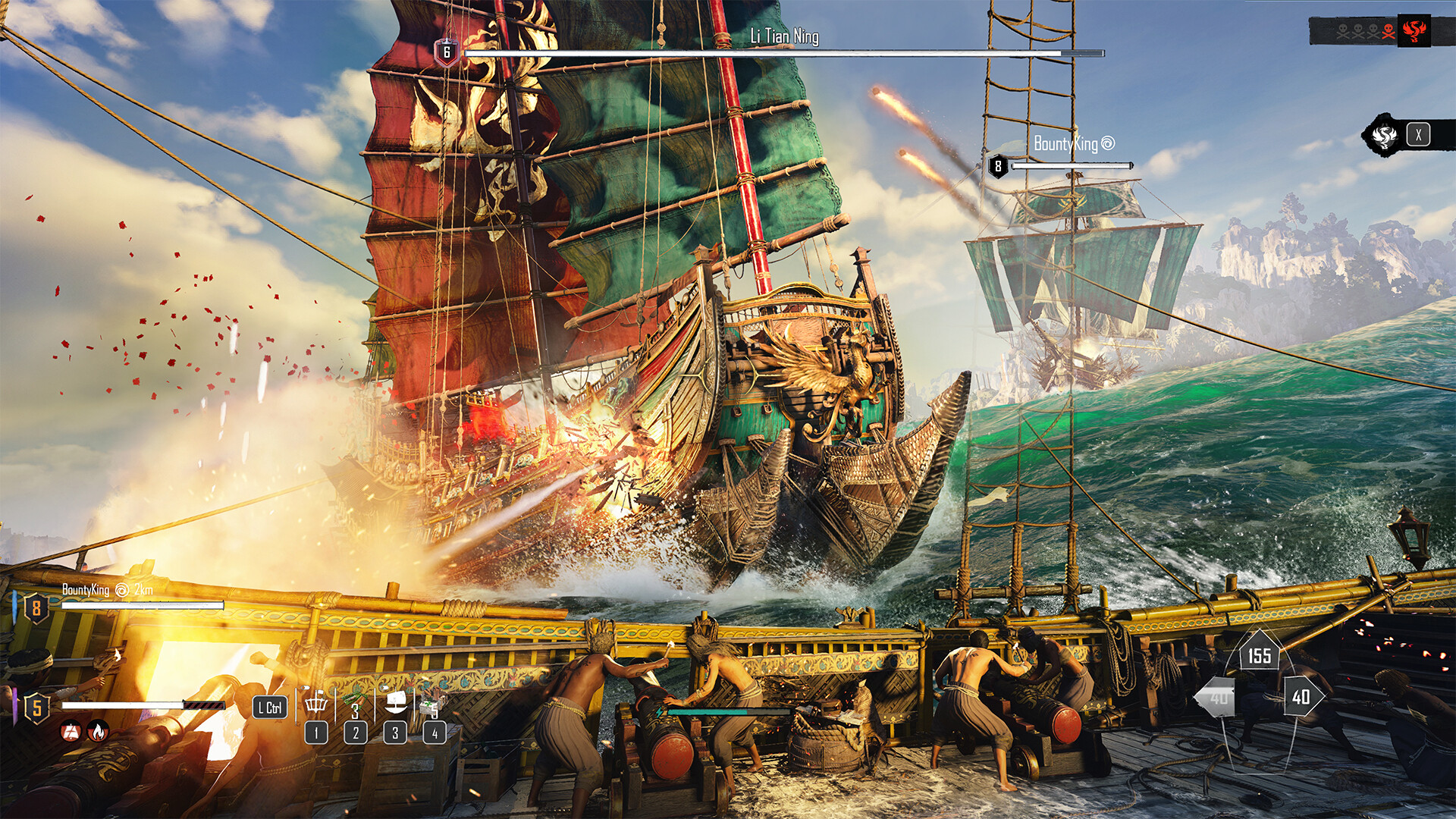
Skull and Bones started as potential expansion content for Assassin's Creed IV: Black Flag. The naval combat in Black Flag, sailing, boarding, managing the Jackdaw, was the most acclaimed part of that game. Players who had no interest in the Assassin's Creed story spent hours at sea. Ubisoft identified a genuine opportunity: extract the maritime content, build a dedicated game around it.
That commercial instinct was sound. What followed was not.
Between 2013 and 2024, the project went through at least five significant creative overhauls. At various points it was a naval PvP title, a PvPvE survival experience, a more narrative-driven maritime game, and ultimately the live service naval combat product that shipped. Each overhaul involved abandoning work already completed, retooling existing assets for a new direction, adding months and years to the schedule.
The mechanism that kept the project alive past any reasonable evaluation window was sunk cost logic. By the time $500M had been spent, cancelling produced an immediate $500M write-off. Shipping something, anything, at least generates some revenue and allows the investment to be partially amortised. This logic is how projects that should be cancelled continue until they become disasters.
I find this dynamic important to understand because it is not unique to Skull and Bones. It is the structural consequence of AAA budget scales that create projects too expensive to cancel. Once a project crosses a certain cost threshold, the financial incentives for continuing and shipping outweigh the incentives for cancelling, regardless of the product's likely quality.
The perverse outcome is that sunk cost logic ensures that the most expensive projects, those with the most troubled development histories, are also the least likely to be cancelled. The very dysfunction that drives costs up also makes cancellation less likely. Each year that passes makes the write-off number larger and the case for continuing stronger, even as the case for the project's eventual commercial success becomes weaker. Skull and Bones in 2017 had already cost enough that cancellation would have been financially painful. Skull and Bones in 2020 had cost enough that continuation looked preferable to any realistic assessment of the product. By 2023, shipping was obligatory regardless of what shipped.
The people at Ubisoft who understood this dynamic, and there were certainly people who did, could not act on that understanding because the organisation's financial reporting structure made the write-off politically impossible. The game that shipped is the direct product of that institutional failure. It is mediocre not because the developers were incapable but because nobody with the authority to make decisions was allowed to make the right one.
What Five Creative Overhauls Actually Cost
The number that is most striking about Skull and Bones is not the total budget. It is the specific cost of indecision.
Five major creative overhauls across eleven years means five periods where the project had to rebuild its design foundations, retool assets that had been built for a different game, and essentially start again in a new direction while maintaining the same codebase and the same team. Each overhaul is not just a delay. It is a destruction of previous work. It is developers who spent months building systems for a PvP game watching those systems become irrelevant when the project pivots to survival. It is environmental artists creating assets for one visual direction that will never appear in the finished product.
This kind of creative waste is also a human cost. Not in the dramatic sense of layoffs, though those came later. In the more insidious sense of a team that spends years making things that get thrown away, watching the project they are supposed to be building keep shifting underneath them. The developers who worked on Skull and Bones during the PvP phase made something. The developers who worked during the survival phase made something. Almost none of it is in the game that shipped. That is a particular kind of professional frustration that accumulates across years and across repeated cycles.
It is also worth naming that the five creative overhauls were not the result of bad luck or unforeseen market changes. They were the result of a decision-making process that could not commit. The maritime game opportunity was real in 2013. The question of what a dedicated naval game should be is not so complex that it requires eleven years and $750M to answer. It required one clear decision, made early, held consistently. Ubisoft's leadership could not make that decision. The developers who worked on the project paid for that inability across a decade of their careers.
The Quadruple-A Moment
The Guillemot interview describing Skull and Bones as quadruple-A is worth examining closely because it reveals something specific about how Ubisoft's leadership understood their own product.
The implicit argument in the term is: production cost equals quality. A game that cost more than standard AAA to produce should be classified above AAA and should command premium perception accordingly. This is not how game quality works and it is not how players think about games. Players do not care what a game cost to make. They care whether it is interesting to play.
But more significantly: Guillemot appeared to believe the enormous production cost was a selling point. That telling customers "we spent $750M on this" would create confidence rather than concern. In 2024, following years of expensive games launching broken and requiring years of remediation, this was profoundly misjudged.
The quote became a meme within hours of publication, across gaming communities that rarely agree on anything. Not because the games press was looking for a target but because it was the perfect encapsulation of a leadership that had genuinely lost contact with how their products were perceived. I find it difficult to read the interview without a specific kind of sadness. This is what happens when the people running a creative organisation have completely lost the ability to see their products through the eyes of the people they are making them for.
It is also, frankly, infuriating as a demonstration of what happens when accountability is removed from the people making creative decisions. Guillemot did not coin "quadruple-A" because he had a communications strategy. He coined it because he appears to have genuinely believed that "we spent more than anyone has ever spent on a game" was a selling point. That belief is only possible in an environment where nobody with direct customer contact had any path to tell a CEO that his customers would find the term embarrassing. The insularity required to produce that interview is the same insularity that produced seven years of creative overhauls and $750M of sunk cost. They are the same failure of organisational design.
What $750M Could Have Built
A useful exercise: $750M at $250,000 per developer per year, fully-loaded cost including infrastructure, tools, QA, and management, would fund a 300-person studio for ten years, or a 500-person studio for six years. Applied to a game with focused creative direction from day one and a design that did not change five times, what could that produce?
The games that have been cited as generation-defining in the same period cost a fraction of that. Elden Ring reportedly cost around $200M. Breath of the Wild reportedly under $100M. Hollow Knight was made by three people for $57,000 raised on Kickstarter.
The relationship between budget and quality in games is not zero. Resources matter, engine technology matters, scope matters. But the relationship breaks down completely at the scale Ubisoft reached with Skull and Bones. There is no game design problem that requires $750M to solve that could not have been solved for $150M with coherent creative direction applied consistently from the start.
The $600M difference is the cost of five creative overhauls, sunk cost decision-making, and an organisation too large and structurally incoherent to maintain a consistent vision across a seven-year development. That $600M produced nothing visible in the shipped product. It bought the privilege of continuing to develop a game that should have been cancelled five years earlier.
What Happened to Ubisoft After
Skull and Bones launched in February 2024. In December 2024, Ubisoft shut down XDefiant, their free-to-play hero shooter that had also failed to find a sustainable audience, and closed the studios responsible, affecting approximately 277 employees. This was the third major Ubisoft live service failure in roughly two years.
Ubisoft's share price, which had peaked above €80 in 2021, was trading near €10 by early 2025. The company that had built Far Cry, Assassin's Creed, and Rainbow Six into global franchises had destroyed approximately 87% of its market value in four years.
I am not gleeful about this. Thousands of developers who had nothing to do with the decisions that produced Skull and Bones, the NFT push, the executive departures, and XDefiant's failure lost their jobs as a consequence. The human cost is real and disproportionately lands on people without power in the organisation.
The people who made the decision to keep Skull and Bones in development across eleven years, who approved each creative overhaul, who green-lit the "quadruple-A" positioning, are not the people who lost their jobs in the subsequent restructuring. They are still at the company, or they departed with substantial compensation packages. The people who spent their careers making a game that kept changing underneath them are the ones who bore the consequences of decisions they had no part in making.
The lesson the industry should take from Skull and Bones is not "Ubisoft made a bad game." The lesson is: creative direction applied consistently from day one will produce a better outcome than eleven years and $750M applied to a project that keeps being redefined. Budget cannot substitute for coherence. Quadruple-A is not a thing. The game should have been cancelled in 2018 when it had already consumed more than most developers' total lifetime output and still did not know what it was.
The structural reform this requires is removing the sunk cost logic from cancellation decisions. A game that has consumed $400M and has no coherent creative direction should be cancelled based on the current state of the project, not preserved because of the cost of the write-off. The write-off is already spent. The question is whether spending another $350M will produce something worth the additional investment. Skull and Bones is a clear demonstration that the answer can be no, and that organisations that cannot arrive at that answer will spend their way to a worse outcome than cancellation would have been.
The naval combat in Black Flag was made in 2013. It is still better than the naval combat in Skull and Bones. That single fact is the most economical possible summary of what eleven years and $750M produced.
The naval combat in Black Flag was made in 2013. It is still better than the naval combat in Skull and Bones. That is worth sitting with.
Skull and Bones is available on PC and consoles. $69.99. Quadruple-A, apparently. I'd play Assassin's Creed IV: Black Flag instead. Better naval combat, made in 2013, $29.99. Let that comparison do what it needs to do.
View on Steam | Play Black Flag instead
Game at a glance
| Detail | Answer |
|---|---|
| Genre | Naval Action |
| Typical length | 20-30 hrs |
| Difficulty | Easy |
| Play mode | Multiplayer |
| Developer | Ubisoft Singapore |