Windrose Roadmap: What's Confirmed, What Shipped, What's Still Rumour
The complete, ongoing story of Windrose's Early Access roadmap. The studio's full origin story, every controversy, every patch, what's confirmed for Ashlands, and links to every system guide. Updated as the game updates, not tied to a year.

TL;DR
- Windrose launched Early Access April 14, 2026. Current status: post-launch stability patches shipped, the next major content update (Ashlands) has no confirmed date.
- Kraken Express estimated Ashlands at 'at least 6 months' from their late-April roadmap post: that puts the earliest realistic date around late October 2026, and as of this writing it hasn't shipped.
- 1.0 full release is targeted for late 2027 to late 2028. No wipes planned, ever. No PvP, no microtransactions confirmed.
- This page is the hub for the whole Windrose guide cluster: system-specific guides are linked throughout, not crammed in here.
Windrose has one of the stranger Early Access stories of 2026: a launch big enough to hit 69,544 concurrent players on day one, a publicly posted roadmap that immediately slipped its own "at least 6 months" estimate, and a developer that's been unusually transparent about the gap between what they've shipped and what they promised. This page tracks that story as it actually happens, not as a snapshot of what was known when it was written. We update it in place as Kraken Express ships things, rather than publishing a new "2027 edition" every January.
Quick Facts
| Early Access launch | April 14, 2026, 8:00 AM UTC |
| Developer | Kraken Express (Tashkent, Uzbekistan) |
| Publisher | Kraken Express (self-published), Pocketpair Publishing (Japan) |
| Price | $29.99, Supporter Bundle $39.99 |
| Steam rating | Very Positive, 87% (51,800+ reviews) |
| Peak concurrent (day one) | 69,544 |
| Copies sold | 2 million+ (as of May 2026) |
| Revenue (first 10 days) | Roughly $30 million gross |
| Team size | Approximately 60, plus occasional outsourced work |
| Current major content | 3 biomes; Ashlands (4th) not yet shipped |
| Next major update | Ashlands biome; no confirmed date |
| 1.0 target | Late 2027 to late 2028, roughly 50% more content planned |
| Wipes planned | None, ever, confirmed by the studio |

The Full Origin Story: Three Names, One Game
Understanding where Windrose is headed means understanding where it actually came from, and it's a genuinely unusual path for a debut studio.
On March 19, 2025, a studio called Crosswind Crew, based in Tashkent, Uzbekistan, announced a game called Crosswind through publisher Forward Gateway. It was pitched as a free-to-play survival MMO set in an alternate Age of Piracy, PvP-focused, with a Steam page and playtest sign-ups opening the same day. Alpha testing began around July 2025. The studio's marketing approach at that stage is worth noting on its own: rather than chasing broad reach, Crosswind Crew deliberately targeted mid-tier survival and MMO specialist creators, names like GameEdged, Waydot, and Kage848, and partnered with ten creators, including Sea of Thieves-space streamers HitboTC and Captain Falcore, for alpha giveaways on July 10, 2025. The bet was that credible niche creators would build a foundation of genuinely bought-in fans more effectively than mainstream advertising, and that the game would find broader attention on its own once that foundation existed.
Five devblogs went out between April and August 2025, and player response to those alpha tests fed directly into a decision that would reshape the entire project: the PvP MMO structure wasn't what players actually wanted. They wanted PvE co-op exploration. Rather than force the original vision through, the studio made what several outlets covering the story called "the brave choice": scrapping a substantial amount of completed work and rebuilding the game around a co-op survival structure instead.
On December 4, 2025, during a gameplay showcase broadcast, the studio renamed itself from Crosswind Crew to Windrose Crew, and the game itself became Windrose. Then, on April 14, 2026, the same day Early Access actually launched, the studio renamed itself a second time, to Kraken Express, the name it operates under today. Asked why, the developers gave an answer refreshingly free of corporate spin: "we are renaming our studio from Windrose Crew to Kraken Express. It just sounds cooler, otherwise, that's still us." Team and leadership stayed unchanged through both renames.
Pocketpair Publishing, the studio behind Palworld, joined as regional publisher for Japan alongside the Early Access launch. Forward Gateway, the original Crosswind-era publisher, no longer appears on the Steam listing.
The Launch Itself
Windrose went live on Steam, the Epic Games Store, and Stove at 8:00 AM UTC on April 14, 2026. Within two hours, it had passed 20,000 concurrent players on Steam alone and was sitting at a Very Positive rating. That number kept climbing through the week, eventually peaking at 69,544 concurrent players, one of the strongest debut openings any pirate-themed game has had on the platform, from a studio that had never shipped anything before.
The broader numbers back up how unusual this launch actually was. Daily active users peaked at 527,000 on the first Sunday and held a floor of roughly 450,000 through the rest of the week. Reported gross revenue crossed $30 million within the first ten days. Against a team of roughly 60 people, that works out to something in the region of $400,000 in net revenue per employee in under two weeks. By the ten-day mark, a third of Windrose's 1.3 million players had already logged more than 20 hours, a genuinely strong retention signal for a debut Early Access title in a crowded survival genre.
Two Controversies From Launch Week
No roadmap story is complete without the friction that shaped it, and Windrose had two genuinely separate controversies land in the same week.
The PC Gamer review. On launch day itself, PC Gamer published a piece under the headline "After 4 hours of pirate survival in Windrose, I'm reinstalling Sea of Thieves." Writer Wes Fenlon's criticisms were specific: one-shot deaths from wildlife felt frustrating, multiplayer felt clunky, and the crafting loop read more like busywork than the swashbuckling adventure the marketing promised. The framing was the real sticking point: recommending an eight-year-old, Microsoft-backed game with years of post-launch polish as the better use of four hours, on the same day a debut Early Access title launched. By the end of that week, Windrose had sold a million copies, and the player base wasn't returning to Sea of Thieves in any numbers that suggested the review changed minds. None of that proves Fenlon's specific criticisms were wrong, since a game can have real, valid problems and still sell a million copies, but it does complicate the "not worth four more hours" framing pretty badly in hindsight.
The Moscow IP routing issue. Separately, players and journalists noticed Windrose's servers were routing through domain names pointing to IP addresses in Moscow. Some ISPs began blacklisting those ranges in response, which terminated connections for players in certain regions during the first week. Kraken Express addressed it directly in a server update shortly after launch, clarifying the technical setup and adjusting routing. The disruption was real for affected players during that window but was resolved without becoming an ongoing issue.
The Patch History
| Update | Date | Contents |
|---|---|---|
| Launch | April 14, 2026 | Early Access release on Steam, Epic Games Store, Stove |
| Early hotfixes | Week 1 | Two critical hotfixes to handle launch-scale server load |
| Phase 1 roadmap post | April 29, 2026 | Kraken Express publishes the first formal roadmap, split into two phases |
| Phase 1 update | April 30, 2026 | 40+ new building pieces, 50+ QoL fixes, performance and connectivity work |
| Stability patch | May 2026 | Third significant post-launch stability patch |
| 0.10.0.7 | June 25, 2026 | Linux dedicated server support (Docker), Traditional Chinese localisation, restored ship sail damage physics |
| 0.10.0.8 | July 8, 2026 | Latest confirmed patch as of this writing |
Three weeks before Early Access launch, on March 23, 2026, Kraken Express had already posted a pre-launch update outlining planned content directions, explicitly framed as not a formal roadmap, with anything in it subject to change or cancellation. That caution turned out to matter once the real roadmap landed a month later.
The April 29 roadmap post split future work into two phases:
| Phase | Contents | Status |
|---|---|---|
| Phase 1 | Performance and connectivity fixes, 50+ quality-of-life changes, ~40 new building pieces, Steam Cloud save fixes | Shipped April 30, 2026 |
| Phase 2, "Ashlands" | New volcanic biome, new factions, new bosses and enemies, new ships, expanded story (continuing the Obol narrative), naval combat improvements | Not yet shipped, see below |
The studio's own words on their approach going forward, from that same post: "Our philosophy now is to enrich the current gameplay systems, instead of only adding new biomes with the respective content... the game will not just grow in size, it will also evolve."
Ashlands has not shipped as of this writing. Kraken Express's own estimate from the April 29 post ("at least 6 months") puts the earliest realistic window at late October 2026, and there has been no newer date posted since a July 1 devblog.
What's Actually Confirmed for Ashlands
| Confirmed | Source |
|---|---|
| Fourth biome, volcanic setting | Kraken Express Steam post, April 2026 |
| Continues the "Obol" narrative thread | Studio communications, mid-2026 |
| New ship classes in development: Brigantine, Fluyt, Galleon | Studio communications, mid-2026 |
| At least one new ship ships alongside naval combat improvements | Same |
| New factions, new high-tier loot | Kraken Express roadmap post |
| No wipes, ever, at any update | Kraken Express, Discord |
What's Still Rumour or Community Request, Not Confirmed
Worth keeping separate from the confirmed list above, because a lot of coverage of Early Access games blurs this line:
- Voice chat: currently absent, ranks near the top of community requests, listed as a planned feature but with no date
- More islands and biome density within existing biomes: a recurring player request, not a confirmed studio commitment
- Additional POIs and enemy types: confirmed as "coming" in general terms, no specifics or timing
- Steam Cloud save improvements: mentioned as a possibility, not formally committed
Every System, Where It Currently Stands
A snapshot of each major system as of this update. Deeper coverage on each lives in the dedicated guides linked below.
Progression and XP. Windrose's least-flagged, most-consequential mechanic: enemy kills give zero XP. All progression runs through Journal quests and Site Clears (fully looting a POI). Solo players focused on quests reach the current level cap of 15 in 8-15 hours; players who fight without an active quest can take 30+ hours to reach the same point.
Biomes. Three currently live: Coastal Islands (levels 1-5), Foothills (6-10), and Cursed Swamps (11-15), with Ashlands as the confirmed fourth zone once it ships.
Ships. Nine buildable hulls across three classes (Ketch, Brigantine, Frigate) and three variants each (Stock, Brethren, Blackbeard). Progression is quest-gated: the "I Need a Bigger Boat" quest unlocks the Shipwright's Workshop, and faction reputation plus Piastre currency gate access to Brigantines and Frigates.
Talents. A branching talent tree with points earned through levelling, generally organised around survival, combat, and utility/sailing specialisations, with a meaningful commitment point around level 10.
Crafting. Multiple dedicated stations handle everything from basic tools through ship components, gated behind progressively rarer materials as you push into later biomes.
Co-op. Up to 4 players per crew standard (8 on a dedicated server, though the developers recommend 4 for stable performance). Shared Quest Progress, enabled in World Properties, gives every crew member full XP for quest completions and Site Clears simultaneously, cutting levelling time roughly in half versus solo play.
Critical Reception: What Reviewers Actually Said
Critic scores for an Early Access title matter less than a finished game's, but the pattern across them is worth knowing because it maps directly onto what the roadmap needs to fix. Metacritic scores from launch-window reviews clustered in the 70-75 range across the outlets that covered it. Not a blowout, but a genuinely strong showing for a debut studio's first release, and notably higher than most Early Access survival titles manage at launch.
The praise was consistent: snappy ground combat, excellent sound design, a base-building system reviewers called intuitive, and points-of-interest design specifically singled out as handcrafted rather than procedurally repetitive. One review put it bluntly: "Windrose is the definitive proof that you don't need a AAAA budget to make an incredible pirate game." Character build variety got real praise too. Greatswords, character traits stacking into critical-hit and survivability builds, food and armor bonuses layering into genuinely distinct playstyles, which is a meaningful thing to get right in an Early Access build.
The criticism was just as consistent, and mapped closely onto what Phase 1's fixes actually targeted: memory leaks, an engine that reviewers felt was "too heavy for its own good" relative to what it was rendering, tedious ground combat friction in specific mission types (one reviewer specifically flagged being mobbed by twenty enemies on a ship deck with no crowd control tools), and naval combat that multiple critics said hadn't fully clicked yet at launch. Several reviews independently converged on the same conclusion: Windrose is meaningfully better in co-op than solo, with shared progression and emergent teamwork covering for rough edges that show more clearly when you're playing alone.
One recurring comparison point is worth calling out directly, because it came up independently across multiple pieces of coverage: reviewers kept measuring Windrose against Skull and Bones, Ubisoft's $750 million naval disaster from the same general genre space. The framing was consistent. "Skull and Bones left pirate game fans with an itch it couldn't quite scratch, leading many to wonder if Windrose might be the solution." A debut studio of roughly 60 people, self-funding a $29.99 Early Access launch, drawing that specific comparison and generally winning it, tells you something real about where AAA naval-combat budgets have actually been going versus what a focused indie team can do with a fraction of the resources.
Who This Game Is Actually For
Being direct about audience fit rather than pretending it's for everyone: if you're playing solo and expecting a tightly scripted narrative experience, the current build's rougher combat encounters and less-refined naval systems will show more. If you're playing with a regular crew of three or four, the reviews and the mechanics both point the same direction. This is where Windrose is currently strongest, and where the roadmap's own stated priorities (co-op-friendly systems, Shared Quest Progress, crew-scaled content) suggest it's staying focused.
The Three Biomes, In Depth
Coastal Islands (levels 1-5). The starting zone, and where the majority of new players spend their first several hours. Resource-dense, built around teaching the core gathering and crafting loop before combat difficulty ramps up meaningfully. Journal quests here expire on biome transition with no on-screen warning. Clear them before pushing into Foothills or you lose that XP permanently.
Foothills (levels 6-10). The first real difficulty step up. Iron-tier crafting opens here, and Veteran Corsair camps become a recurring, genuinely dangerous encounter type rather than an occasional one. This is also where most players make their first Brigantine push, since Foothills-tier faction quests are what unlock the reputation needed to move past the Ketch.
Cursed Swamps (levels 11-15). The current endgame zone before Ashlands ships. Enemy density and difficulty both increase noticeably, and this is where the game's boss encounters, Thomas Richards among them, become the actual gating challenge rather than general combat difficulty. Steel-tier gear becomes available and largely necessary here; armor with a mix of Iron and Steel pieces shows a real efficiency gap (reviewers and community guides both cite figures in the 30-40% range) against players still running full Iron sets.
Crafting and Progression Systems, In More Depth
Windrose's crafting runs through multiple dedicated stations rather than one universal bench, which is a deliberate friction point: it forces you to actually build out a functional base rather than crafting everything from a single hub. Early stations handle basic tools and building materials; later stations gate ship components, armor upgrades, and Steel-tier gear behind progressively rarer resources pulled from deeper biomes. A disassembly station lets you break down obsolete gear picked up from pirate camp loot into base materials, a genuinely useful passive income source for nails, copper, and other mid-tier components that otherwise require dedicated mining runs.
The armor system runs three tiers, Stone, Iron, and Steel, across five equipment slots, and tier mixing has real, measurable consequences rather than being a purely cosmetic choice. The Talent system layers on top of all of this: points earned through levelling, split across branches generally organised around survival (health, stamina, damage resistance), combat (melee damage, attack speed, crit chance), and utility/sailing (gathering efficiency, ship handling, crafting bonuses), with a genuine build-defining commitment point that shows up around level 10.
Every Ship, In Full
The full breakdown for readers who want ship detail without leaving this page. The dedicated Best Ships Guide covers unlock paths and build recommendations in more depth.
| Ship | Class | Hull HP | Speed | Cannons | Unlock Cost |
|---|---|---|---|---|---|
| Stock Ketch | Early | ~50,000 | ~19 kn | 3x 12-pounder | Free, build a Wharf |
| Blackbeard Ketch | Early | Lower | Fastest Ketch | Can mount 24-pounders | Wharf + faction rep |
| Brethren Ketch | Early | Tankiest Ketch | Slower | Standard | Wharf + faction rep |
| Stock Brigantine | Mid | ~50,000 | ~22 kn | 6x (12lb or 24lb) | Brethren of the Coast Rep 2, 1,000 Piastre |
| Blackbeard Brigantine | Mid | ~50,000 | Fastest Brig | Only Brig variant that can mount 24-pounders | Same as Stock |
| Brethren Brigantine | Mid | ~90,000 | Slower | Standard | Same as Stock |
| Stock Frigate | Late | ~160,000 | Standard | Standard | Brethren of the Coast Rep 4, 3,000 Piastre |
| Blackbeard Frigate | Late | ~110,000 | 20 kn | 12x 24lb/36lb main + 6x 12lb/24lb secondary | Same as Stock, plus gear unlocks |
| Brethren Frigate | Late | Highest in class | Slowest Frigate | Standard | Same as Stock |
The genuine debate at the top end, Blackbeard Frigate for speed and engagement control versus Brethren Frigate for raw tankiness in prolonged fights, doesn't have a single correct answer, and any guide claiming otherwise is oversimplifying. Both are legitimate endgame picks depending on crew size and playstyle.
Faction Reputation, Explained
Nearly every meaningful unlock in Windrose, ships, cannons, hull upgrades, gates behind faction reputation rather than pure currency or crafting level, and understanding the faction structure early saves real time. Brethren of the Coast is the central faction for ship progression specifically: Reputation 2 unlocks the Brigantine tier, Reputation 4 unlocks Frigates. Smugglers of Port Royal governs a separate track tied to hull bracing and defensive upgrades. Levelling this faction to Rank 2 unlocks Keelhold, the hull bracing option that meaningfully closes the durability gap on faster, lighter ship variants. Rogue Buccaneers gates access to heavier cannon tiers, with Rank 4 specifically required for 36-Pounder cannons, the heaviest available broadside in the current build.
Reputation and Piastre currency are, in practice, the actual bottleneck across the entire ship and gear progression system. Crafting materials are comparatively easy to farm once you know where to look; faction standing takes sustained quest completion to build.
Naval Combat Basics
Naval engagements run on a positioning-first system rather than a pure damage race. The two dominant tactical approaches players have converged on are Broadside, lining up parallel to a target and trading full-side cannon volleys, and Storm Rider, a hit-and-run approach that uses a ship's speed advantage to control engagement range, firing and disengaging before the target can bring its own full broadside to bear. Which one works better depends heavily on your hull choice: Blackbeard variants, built around speed, favour Storm Rider; Brethren variants, built around raw durability, favour standing and trading in a straight Broadside fight. This is the same tension that shows up in the Frigate debate above, just expressed as combat doctrine rather than hull stats.
The Pocketpair Connection
Pocketpair's involvement as Windrose's Japan-region publisher is worth its own mention, because it's a genuinely interesting signal about how the studio is being read within the industry. Pocketpair made Palworld, a similarly explosive Early Access launch from a small team that massively outperformed expectations, then faced its own long stretch of community patience around post-launch content cadence. A publisher with recent, direct experience managing player expectations through exactly that kind of gap choosing to back Kraken Express for regional publishing isn't proof of anything on its own, but it does suggest Pocketpair saw something in Windrose's early trajectory that matched a pattern they'd already lived through successfully once.
Community and Communication
Windrose's official Discord has grown to roughly 53,000 members, and the "Windrose Community Review & Feedback" thread remains the primary channel the studio uses to gather structured player input outside of Steam reviews directly. That channel was directly credited with shaping the original Crosswind-to-Windrose pivot during the 2025 alpha period, and the studio has continued treating it as a genuine input source rather than a symbolic gesture. The ~40 building pieces added in the Phase 1 update were explicitly described by the studio as influenced by player creativity and requests logged there, not an internally-generated feature list.
The recurring community requests that haven't yet become confirmed roadmap items are worth tracking separately from confirmed content, which is exactly why this page keeps those two categories in separate sections above rather than blurring them into one undifferentiated "what's coming" list.
How Windrose's Roadmap Compares
It's worth putting this in context against how other successful Early Access survival games have handled the exact same stretch of development. Valheim, probably the closest comparison point in tone and scope, went nearly a year between its initial burst of post-launch content and its first truly major biome expansion, and took real criticism for the gap even while maintaining a large playerbase throughout. Windrose's "at least 6 months" estimate for Ashlands, landing roughly two and a half months after launch, is actually a faster committed cadence than that comparison suggests, assuming it holds, which as of this writing it hasn't yet.
What's genuinely different here is the transparency. Kraken Express published an actual dated-ish roadmap (with the explicit caveat that dates could move) rather than staying silent between content drops, and continued posting devblogs and interim patches through the gap rather than going quiet. That's not nothing for player trust, even when the headline update itself is running behind its own estimate.
What You Should Actually Expect
Being direct about this rather than hedging: Windrose's studio has been unusually honest about scope and timelines so far, and has shipped real interim value (the Phase 1 update, the Linux server support, the sail physics fix) rather than sitting silent while a single mega-update cooks. That's a genuinely good sign for a debut studio. It's also true that the flagship promise, Ashlands, has already slipped past informal expectations even if it hasn't technically broken the studio's own stated minimum estimate yet. Treat "at least 6 months" as a floor, not a target, and you won't be disappointed by the actual timeline.
The Monetisation Philosophy
Worth stating plainly because it's genuinely unusual in 2026's Early Access landscape: Windrose has no microtransactions and no PvP, and both are treated by the studio as settled decisions rather than open questions. The Supporter Bundle, soundtrack and wallpapers for an extra $10, is the entire additional-spend surface of the game. There's no cosmetic shop, no battle pass, no seasonal content gate. For a studio that could plausibly have leaned into live-service monetisation given how explosively the launch performed, choosing not to is a real signal about what kind of long-term relationship they're trying to build with the playerbase, not just a launch-week talking point.
What Ashlands' Theming Suggests
Kraken Express has confirmed Ashlands as a volcanic biome continuing the "Obol" narrative thread, without detailing exactly what that thread is yet. Reading between the lines of what's been said: the existing three biomes progress from temperate coastal islands through increasingly hostile terrain to the undead-adjacent Cursed Swamps, and a volcanic fourth zone fits a pattern of escalating environmental hostility that tracks with the difficulty curve players already experience through the level 1-15 arc. New factions and high-tier loot being confirmed alongside it suggests Ashlands isn't just a reskinned difficulty bump but a genuine new act, consistent with the studio's stated "evolve, not just grow" philosophy.
Server Hosting and Save Practices
Windrose supports dedicated servers, with Linux support (via Docker) added in the June 25 patch specifically to broaden self-hosting options beyond Windows. For crews running longer-term persistent worlds rather than session-based play, a dedicated server keeps the settlement and fleet running without requiring the host player to be online. Steam Cloud save support exists but has been flagged by the community as an area needing improvement. Not broken, but not yet as robust as some players would like for a game with no planned wipes and potentially years of persistent progress ahead of it. Backing up local saves manually before major updates remains sensible practice regardless.
Community Sentiment, Beyond the Aggregate Score
The Steam review aggregate (87% Very Positive) tells only part of the story worth knowing. Digging into the actual discourse in Windrose's Steam community forums surfaces a genuinely useful pattern: a meaningful share of negative reviews are, by the community's own assessment, difficulty complaints from players who hadn't realised Captain's Choice difficulty sliders exist, rather than issues with the game's actual design. That's not a dismissal of every piece of negative feedback. Reviewers and community members alike raise real, specific issues around co-op coordination, wind mechanics in sailing feeling underutilised, and combat inconsistency, but it's a useful filter for reading review sentiment: separate the "the game doesn't do enough to explain its own settings" complaints from genuine design critique, because they get bundled together in the aggregate score in a way that doesn't serve either category fairly.
Roadmap FAQ
Is Windrose worth buying before Ashlands ships?
Yes, on the strength of what already exists. Three full biomes, nine ships, a complete talent and crafting system, and roughly 8-15 hours of core content even before factoring in exploration and base-building. You're not paying for a promise; the current build is a genuinely complete game on its own terms.
Will my progress carry over when Ashlands releases?
Kraken Express has explicitly stated no wipes are planned at any point, including major content updates like Ashlands.
Is Windrose coming to consoles?
Not confirmed as of this writing. The studio has acknowledged interest in a console version but has made no formal commitment or timeline.
How does Windrose's price compare to what's actually in the game?
At $29.99 for a complete three-biome, nine-ship, full-progression Early Access build, it undercuts most AAA Early Access pricing while offering more systemic depth than many full-price competitors.
Why did the studio rename itself twice?
Crosswind Crew became Windrose Crew alongside the December 2025 name change from Crosswind to Windrose, then Windrose Crew became Kraken Express on the same day Early Access launched. Both were framed by the studio as simple, low-drama rebrands rather than signalling any change in team or direction.
Is Windrose actually finished enough to be worth full price, or should I wait for a sale?
There's genuine content here: three biomes, nine ships, a full talent tree, complete crafting progression, and the $29.99 asking price already sits below most comparable Early Access survival titles. Waiting for Ashlands specifically makes sense if you want the fuller vision; waiting for a discount makes less sense given how little headroom the price already has compared to what's included.
What happened to the original Crosswind PvP concept entirely?
It was scrapped, not folded into Windrose in reduced form. Community response during the 2025 alpha showed a clear preference for PvE co-op over the original PvP MMO structure, and Kraken Express rebuilt around that preference rather than trying to retrofit PvP elements into the new direction. There's no PvP in Windrose, and the studio has treated that as a settled decision rather than an open door.
Is the Moscow server routing issue still a problem?
No. Kraken Express addressed it directly in a server update shortly after launch, adjusting routing and clarifying the technical setup. It disrupted some players during the first week specifically but hasn't recurred as an ongoing issue since.
Does Windrose require a powerful PC to run well?
Reviewer feedback at launch flagged real performance issues, including memory leaks, tied to running Unreal Engine 5 at a weight some critics felt was heavier than the visuals justified. The Phase 1 update specifically targeted performance and connectivity, and subsequent patches have continued addressing stability, though this remains an area worth checking current patch notes on if you're running older hardware.
How does Windrose compare to Valheim or other survival co-op games?
Structurally closer to Valheim than to Sea of Thieves. Base building, biome-gated progression, and a genuine survival loop underpin the pirate theming, rather than the theming being the whole experience. The naval combat and ship progression system is Windrose's clearest point of differentiation from other entries in the genre.
The Story Bosses
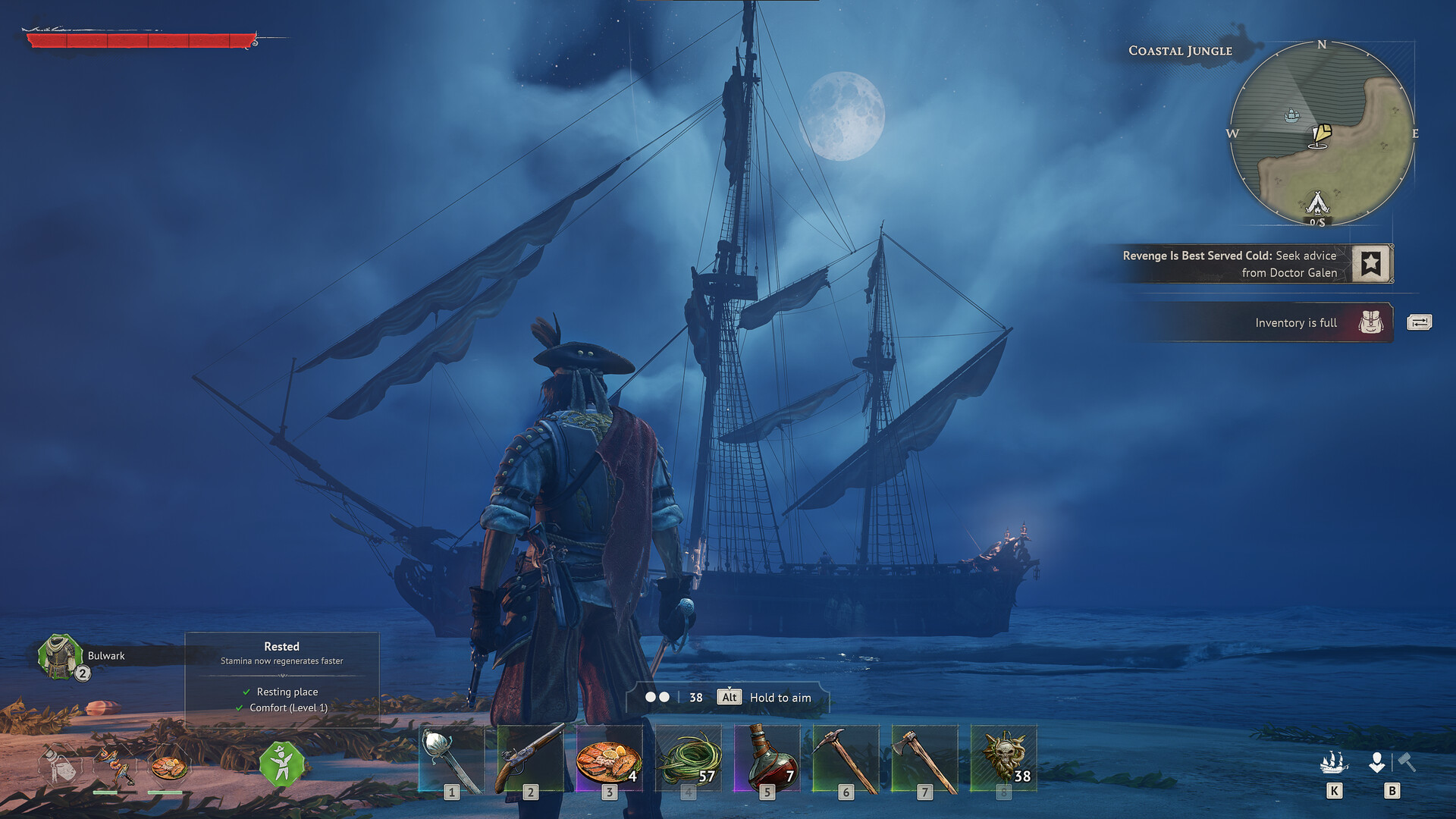
Three story bosses are confirmed and consistently corroborated across independent coverage: Thomas Richards (Coastal Jungle, the end of the "Revenge is Best Served Cold" questline, gated behind collecting four Black Marks from Blackbear Outposts), Israel Hands (Foothills, via the "Needle in a Haystack" questline, drops the Soul Eater greatsword), and the High Priestess (Cursed Swamps, the current final story boss). Each gates the next biome's crafting tier. You can't meaningfully progress past a boss's zone without beating them, and each is tuned hard enough to demand full gear investment for that tier before attempting it. Thomas Richards specifically expects Level 5 weapon and full five-piece armor upgrades before the fight is remotely fair; going in undergeared means his unblockable grab attack one-shots you rather than the fight being merely harder.
A note on accuracy worth flagging directly: some coverage online references a fourth, optional "Ghost Captain" boss in a "Temple Dungeon." We checked this claim the way we check everything on this page, against Steam's own community discussions and multiple independent sources, and couldn't corroborate it anywhere beyond a small number of guide sites repeating each other. Rather than present it as confirmed content, we're flagging it as unverified and leaving it out of the confirmed list above. If that changes, this section gets updated.
On Israel Hands specifically: the Foothills boss trades Thomas Richards' pure melee pressure for a mixed-range fight, with a Poison Lunge that punishes standing still and a Spirit Cannon attack that rewards evasion over the parry-heavy approach that works against Richards. Community consensus is consistent on this point: players who try to parry through the Israel Hands fight the same way they handled Richards tend to struggle noticeably more than players who adapt to dodging instead, since several of his attacks aren't cleanly parriable the way Richards' combos are. The Soul Eater greatsword drop is widely considered one of the strongest mid-game weapons available before Cursed Swamps gear becomes accessible.
On the High Priestess: the current final story boss, gating access to Steel-tier crafting and standing as the actual difficulty ceiling of the game before Ashlands ships. Her fight introduces a pustule system layered on top of the poise-break mechanics the first two bosses use. Damaging the pustules first opens a separate stagger window distinct from standard posture breaking, and her most dangerous punish window comes specifically after that secondary stagger rather than during normal combo openings. Gear checks matter even more here than in the earlier fights; going in with anything less than full Steel-tier investment tends to turn the fight into an exercise in frustration rather than a fair, if difficult, challenge.
What Phase 1 Actually Fixed
Worth a closer look than "40+ building pieces, 50+ QoL changes" as a bare number, since the specific character of those changes tells you what the studio prioritised first. Building expansion was the headline addition, a meaningful jump in settlement design options, directly credited by the studio to player requests logged in the community feedback channel. The quality-of-life changes clustered around performance and connectivity specifically, which lines up precisely with what critic reviews flagged hardest at launch: memory leaks and an engine running heavier than the visuals justified. Steam Cloud save fixes rounded out the update. What Phase 1 didn't touch: new content, new biomes, new story. That was a deliberate sequencing choice: fix the foundation before building on top of it, which is a genuinely healthier order of operations for a survival game than rushing new content over an unstable base.
The Talent Tree, In Full
Windrose's talent system splits into three branches, and the choice of where to commit early points matters more than in most survival games because respeccing has real friction. The survival branch (sometimes referred to by community guides as Toughguy) increases max health, stamina, and damage resistance, the recommended default for the first 10-15 levels regardless of eventual build, because dying repeatedly to avoidable damage costs more time than any other early-game mistake. The combat branch (Swashbuckler) boosts melee damage, attack speed, and critical hit chance, and rewards players already confident in the parry-and-block rhythm rather than still learning it. The utility and sailing branch (Mariner) improves gathering efficiency, ship handling, and crafting bonuses, and tends to pay off more in the mid-game once multi-island exploration becomes the dominant activity rather than early survival.
The genuine build-defining moment lands around level 10, where a meaningful commitment point locks in a specialisation direction rather than letting you freely mix all three branches indefinitely. Most community-sourced build guides recommend front-loading survival investment specifically so that commitment point is reached with a genuinely solid health and stamina foundation already in place, rather than trying to specialise into combat or utility while still fragile.
A Note on Sourcing
Everything on this page is cross-checked against multiple independent sources before it goes in the confirmed sections, not just repeated from whichever guide site said it first. Where sources genuinely disagreed (the Brethren-versus-Blackbeard Frigate debate, the unverified "Ghost Captain" boss claim), we've said so directly rather than picking one version and presenting it as settled. Live Steam data (review counts, ratings, pricing) is pulled directly from Steam's own API rather than estimated from secondary coverage. This page gets re-verified against current patch notes whenever it's substantively updated, not left to drift.
The Bigger Picture
It's worth stepping back from the specifics for a second. A roughly 60-person studio in Tashkent, Uzbekistan, landlocked, notably, for a pirate game, built something that out-earned entire AAA naval-combat budgets in its first ten days, while Ubisoft spent $750 million and seven years producing a game that undersold its break-even target. That's not really a story about Windrose specifically. It's the same story this site has been telling all year about where creative risk in this industry actually lives now: a small team with genuine focus, transparent communication, and a willingness to scrap a year of completed work when the community told them the original vision was wrong, consistently outperforming organisations with a hundred times the budget and none of the flexibility to actually listen. Windrose's roadmap slipping its own six-month estimate is a real, worth-tracking fact. It's also a much smaller problem than the ones that sink games built the other way.
The Complete Windrose Guide
This is the hub. The system-specific depth lives in dedicated guides, kept current independently:
- Beginner Guide (1,534 words). First-hour priorities and the most common early mistakes
- XP & Leveling Guide (1,482 words). Why enemy kills give zero XP, and what actually progresses you
- Talent Tree & Builds Guide (1,488 words). All branches, the level 10 commitment point, build priorities
- Best Ships Guide (1,470 words). Every ship compared, tier by tier
- Co-op & Multiplayer Guide (1,498 words). Crew setup, Shared Quest Progress, communication
- Crafting Guide (1,499 words). Every station, build order, material gating
- How Long to Beat Windrose (1,539 words). Solo vs. co-op time to current content cap
How We Keep This Page Current
No year in the title, no "2026 edition". When Ashlands ships, this page gets updated in place with what actually shipped, not archived in favour of a new post. Check the modified date above rather than assuming anything here reflects launch-week information.
Windrose is available now in Early Access on PC. $29.99.
Buy on Steam