Subnautica 2 Early Access Review: How Much Is Actually in the Game? (July 2026)
Subnautica 2 has been in early access for seven weeks. Vehicles, biomes, maximum depth, the no-weapons controversy, how it compares to Subnautica 1, and whether to buy it now.

TL;DR
- Buy now if you want to watch a good game get better. Wait for 1.0 if you want a complete story -- the price rises at full release.
- 2 million copies sold in the first 12 hours, 460,000 peak concurrent players on day one.
- No weapons against aggressive creatures -- a deliberate, unchanging design choice, though the current toolkit needs improvement.
- Krafton tried to avoid a $250 million bonus owed to the founders. A Delaware court ruled it breach of contract.
Buy it. With caveats I'll be specific about.
Subnautica 2 launched into early access on 14 May 2026 on Steam, Epic Games Store, and Xbox Game Pass. It sold 2 million copies in its first 12 hours. It peaked at 460,000 concurrent Steam players on day one, beating out AAA titles that cost three times as much to make. The most wishlisted survival game in years showed up, and it showed up in decent shape.
I've been playing since launch. This is not a launch-day impressions piece. This is what the game actually is now, seven weeks in, post-Hotfix 3, with enough hours to have opinions that aren't based on novelty.
Price: £25 on Steam and Epic. Day one on Xbox Game Pass Ultimate and PC Game Pass. Price increases at 1.0. One purchase covers all Early Access content updates through full release.
Platform: PC (Steam + Epic), Xbox Series X/S. No PS5 version confirmed yet.
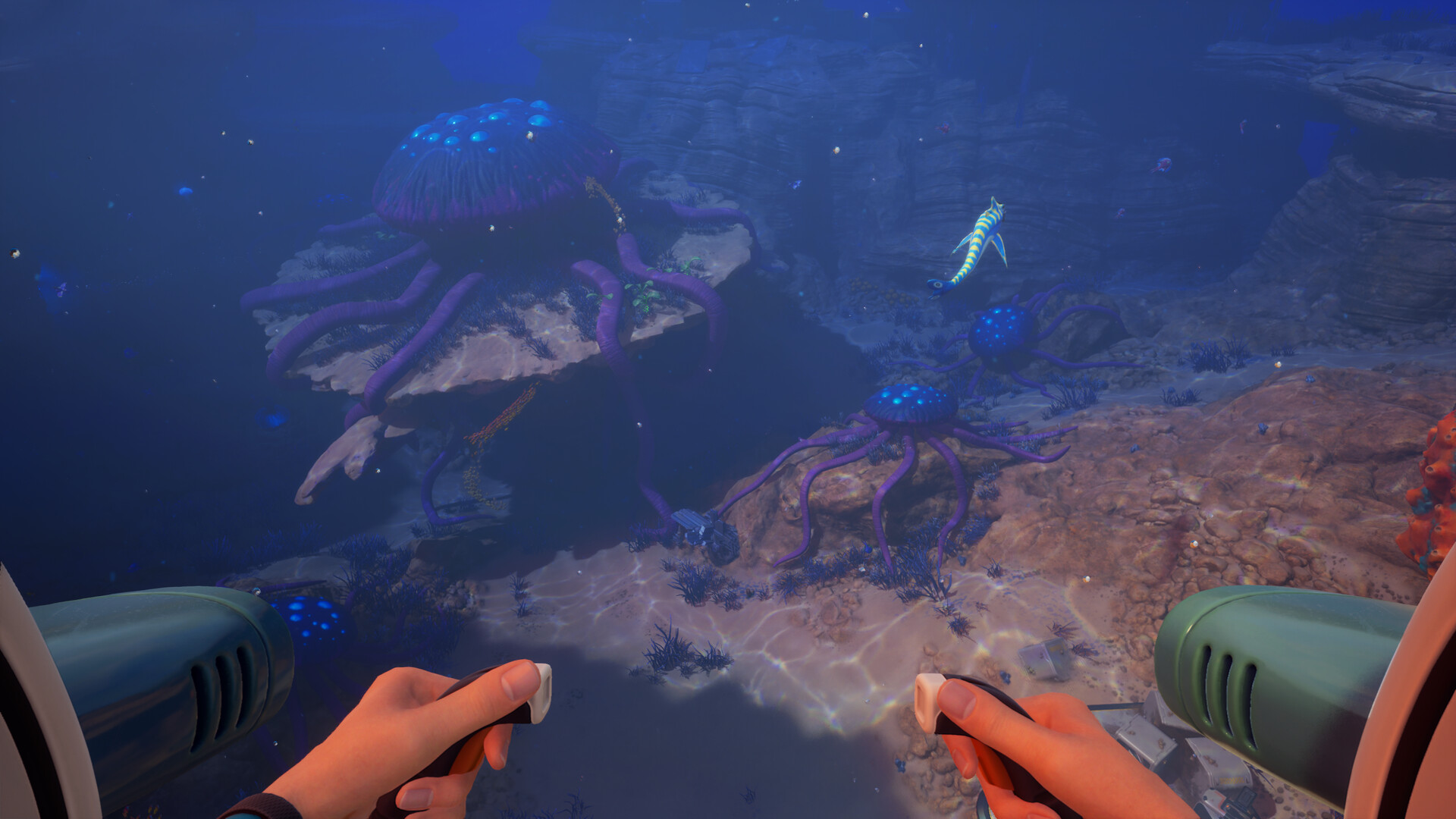
What Subnautica 2 Actually Is
Before comparing it to the original, let's establish what you're actually buying.
You are on Zazura. Not Planet 4546B. A completely different alien ocean world. The colony ship CICADA, carrying 40,000 people, was 250 times larger than the Aurora from the first game. Its crash is described in-game as the worst accident in Alterra's history. You were one of the passengers. You are not the only survivor. You just might be the only one left.
You wake up in a survival pod. An AI called NoA handles orientation, reprinting you when you die, and feeding you story information. The ocean stretches in every direction. Something large moved past you while you were reading this paragraph.
The survival loop will be immediately familiar. Gather resources. Scan equipment. Build the thing. Build a better thing. Go deeper. The formula is essentially unchanged from the original because the formula works, and Unknown Worlds have correctly identified that the thing players wanted more of was more Subnautica, not a reinvented game.
What is different is everything surrounding that loop. New planet. New creatures. New biomes. New vehicle system. New base building. A co-op layer that didn't exist in the original. And one contentious design decision about weapons that split the community within 24 hours of launch.
Subnautica 2 vs Subnautica 1: The Honest Comparison
Let's get the comparison out of the way properly, because "is it better than the first game" is the question everyone actually wants answered.
The short answer: not yet. The longer answer: the potential is there, and in some specific ways it's already better.
Content Depth at This Stage
| Feature | Subnautica 1 (Full Release) | Subnautica 2 (Early Access, July 2026) |
|---|---|---|
| Biomes | 14+ | 6 |
| Vehicles | 3 (Seamoth, Prawn Suit, Cyclops) | 1 + 2 chassis variants (Tadpole) |
| Story hours | 25-35hr | 12-15hr story arc |
| Total exploration hours | 40-60hr | 20-25hr |
| Max depth (upgraded) | 1,700m (Prawn Suit) | 250m base, 450m with Depth Module Mk.1 (800m Mk.2 exists but Creative Mode only) |
| Co-op | No | 1-4 players |
| Base building | Good | Significantly improved |
| Engine | Unity | Unreal Engine 5 |
What Subnautica 2 Does Better Right Now
Base building. There is no contest. The original's base building was functional and occasionally beautiful but fundamentally limited. Subnautica 2's system was rebuilt from scratch. Senior gameplay engineer Milan Singh said at GDC 2026 that the new approach uses techniques "that haven't been used in games this way before." Windows are no longer circular portholes. You can paint different sections. Lighting is customisable room by room. The result is bases that look like places someone would actually live in rather than plumbing diagrams.
Visual fidelity. Unreal Engine 5 is making some large studios look foolish right now. It's making Subnautica 2 look extraordinary. The night-time sequences, where the bioluminescence of creatures and plants creates a living light show in complete darkness, are some of the most visually striking moments I've had in a game this year. The original Subnautica's safe shallows at night were already special. Zazura at night is on another level.
Co-op. The original was a solo experience by design. Subnautica 2 was built from the ground up for optional co-op with up to three friends. The key word is optional. Playing solo doesn't feel like playing a multiplayer game with the multiplayer removed. It feels like playing a Subnautica game. Playing with friends adds a coordination layer that makes long dives more viable and resource gathering more efficient, but it does slightly undermine the isolation that made the original feel uniquely oppressive. The ocean is less frightening when there's someone on comms with you. That's a design trade-off Unknown Worlds made knowingly, and it's the right one for a 2026 survival game.
Performance on launch. Unreal Engine 5 has a reputation. The concern was legitimate. The reality is that it runs considerably better than it had any right to for an Early Access launch. Hotfix 3 addressed the most significant performance issues. On a mid-range modern rig, frame rates are stable and the odd stutter when entering new areas as assets stream in is the worst of it. Unknown Worlds allegedly has a dedicated performance team working through Early Access. It shows.
What Subnautica 1 Still Does Better
Atmosphere. The original Subnautica was quiet. You were alone. The ocean told you things through audio logs and environmental storytelling and the horrible low frequency rumble of something enormous moving beneath you. You could be swimming in what appeared to be completely empty water and then realise, gradually, that you'd been followed for the past three minutes.
Subnautica 2 has NoA. NoA never stops talking.
She has a line for everything. She offers guidance unprompted. She comments on things you've just done. She delivers dialogue at a pace that makes the early game feel significantly more guided than the first game ever did. I understand what they were going for: a character with her own arc and secrets that you gradually uncover. The execution means that the first four hours of Subnautica 2 feel like a game explaining itself to you, where the first four hours of the original felt like being dropped into the ocean and told to deal with it.
NoA calms down once the story kicks into gear. The dialogue stops feeling like handholding and starts feeling like narrative. But the early-game experience is meaningfully different from the original, and not always in ways that serve the game's strengths.
Creature threat. The Reaper Leviathan in the original Subnautica was terrifying because the tension never fully resolved. You could avoid it. You could learn its patrol patterns. You could get past it. But you could never make it not a threat. It was always there. The fear was constant and earned.
Subnautica 2's aggressive creatures are less threatening once you understand the toolkit available to deal with them. Which is: throw a flare and run. That's it. We'll cover this in its own section because it deserves one.
Vehicle roster. Subnautica 2 currently has one vehicle. Subnautica 1 at full release had three extraordinary ones. This is the most significant practical gap between the two games right now, and it deserves proper treatment.
The Vehicle Problem
This is the section that will determine whether you find Subnautica 2's Early Access state acceptable or genuinely lacking.
Subnautica 1's Vehicle Trio
Let me explain why the vehicles in the first game were so important, because understanding them is understanding what's missing right now.
The Seamoth was your first real vehicle. A one-person scout submarine, fast, manoeuvrable, capable of reaching depth of 900m with full upgrades. It let you cover distances that swimming couldn't. It gave you a portable oxygen supply. It was the thing that turned Subnautica from a terrifying survival game in a small area into an exploration game across a vast ocean. The moment you first built a Seamoth and drove it out of your Moonpool felt like a key turning in a lock.
The Prawn Suit was something else entirely. A bipedal mechanical exosuit built for extreme environments. 900m base depth, 1,700m fully upgraded. Armed with interchangeable arm attachments: a claw arm for moving objects and a drill arm for extracting hard minerals from terrain. A grappling hook upgrade that let you swing through underwater cave systems. A jetpack upgrade. It was slow. Brutally, hilariously, terrifyingly slow in open water. That slowness was the point.
The experience of taking a Prawn Suit into the depths of Subnautica's late-game biomes is something that's difficult to describe to someone who hasn't done it. You'd enter a cave system. You'd go deeper. The temperature would drop in the audio design. The light would fall away. And eventually you'd reach a point where you were 1,200 metres below the surface, moving at walking pace through an alien cavern, your air supply holding but barely, your path back to the surface requiring you to walk out the same way you walked in because the Prawn can't actually ascend quickly through open water.
The feeling of being genuinely trapped, not dead but genuinely unable to get out quickly, is something no other game has ever given me. Not horror games. Not permadeath survival games. Subnautica's Prawn Suit in the deep zones. It remains one of gaming's most profound mechanical experiences because it made the scale of what you were doing feel real.
The Cyclops was the capstone. A 54-metre submarine. The largest player-controlled vehicle in the game. Not fast. Not agile. Not quiet, which mattered because the Cyclops attracted predators. But it was a mobile base. You could build fabricators inside it. You could grow food in aquariums inside it. You could store essentially unlimited resources inside it. And crucially, it had a vehicle bay in its belly that could carry a Seamoth or a Prawn Suit.
This is the thing you asked about, and yes: the Cyclops could carry the Prawn Suit. One vehicle at a time, Seamoth or Prawn. You'd park the Cyclops above a deep biome, drop out in the Prawn Suit, do what you needed to do, and ascend back to the Cyclops to dock. The Cyclops charged the Prawn's power cells while docked. The combination meant you could take expeditions to the deepest parts of the game and return safely because you always had a mobile home base above you.
The size of the Cyclops made the ocean feel correctly scaled. You could be inside a 54-metre submarine and look out the window at a creature larger than your vehicle and feel the appropriate existential weight of what you were doing. Nothing in Subnautica 1 communicated the alien enormity of the ocean as effectively as piloting a Cyclops through deep water and realising the thing you thought was terrain was moving.
Subnautica 2's Vehicle Answer
The Tadpole is Subnautica 2's current vehicle. It is Subnautica 2's only vehicle. It is a compact, single-seat submersible roughly equivalent to the Seamoth in role but with a fundamentally different design philosophy. (Full breakdown, including exact stats and what's confirmed versus currently playable: Subnautica 2 Vehicles Guide.)
Where Subnautica 1 gave you three distinct vehicles for distinct purposes, Subnautica 2 gives you one modular vehicle that you adapt for different purposes through a chassis system.
Base Tadpole: Your starting vehicle. Fast enough, manoeuvrable, four upgrade slots. Gets you into mid-game biomes and makes longer dives viable. A perfectly functional piece of kit that does not feel exciting in the way the Seamoth felt exciting because it lacks the "I built this from scratch and now the ocean is different" moment. It should feel exciting. The formula is the same. Something about the pacing around unlocking it doesn't deliver the same payoff.
Scout Ray Chassis: A Tadpole chassis that maximises speed. Highest swim acceleration of any current vehicle at 1,600 cm/s². Best choice for covering large distances quickly. The variant you want for exploration and biome mapping.
Haul Chassis: A Tadpole chassis focused on cargo capacity. Extra storage, slower. The variant you want for resource farming expeditions. Importantly: cargo in the Tadpole survives your death in a way personal inventory doesn't, which makes it a meaningful strategic choice.
Seafrog Chassis (not yet available in standard survival): An exosuit-style chassis that lets the Tadpole walk on the seabed. This is the closest thing to a Prawn Suit in the current build, and it is not currently available through normal gameplay. It's confirmed as existing in the game's systems, but it's not yet wired into the standard progression.
The Trident: The Cyclops equivalent. Confirmed by Unknown Worlds, multi-crew submarine, successor to the Cyclops, confirmed for a later Early Access update. Not in the current build. Not even close to the current build.
The Vehicle Comparison
| Vehicle | Subnautica 1 | Subnautica 2 EA (July 2026) |
|---|---|---|
| Scout/Fast sub | Seamoth | Tadpole (Scout Ray Chassis) |
| Heavy cargo sub | N/A | Tadpole (Haul Chassis) |
| Deep exosuit | Prawn Suit | Seafrog Chassis (not available) |
| Mobile base submarine | Cyclops (54m, carries 1 vehicle) | Trident (coming later) |
| Depth modules | Yes, both Seamoth and Prawn | Yes, Tadpole |
| Docking with base | Moonpool | Moonpool + Vehicle Dock |
Unknown Worlds know this. They're not being coy about it. The roadmap explicitly commits to expanding the vehicle roster. The franchise history suggests they'll get there.
How Much Content Is Actually in the Game
The question people are actually searching for, answered directly.
Story content: 12 to 15 hours if you follow objectives without getting lost. Go slowly, explore everything, spend time on base building, and you'll get 20 to 25 hours before you hit the end of the current early access arc.
The ending: It's a deliberate cliffhanger. Not an abrupt cut. An actual ending that pauses the story at a satisfying moment while making clear that what you've experienced is Chapter 1 of something larger. You will feel it arriving before it arrives. There's a "that's all for now" message. Several reviewers have described it as the correct way to end an early access content chapter rather than just running out of game.
For context: The Steam community consensus is that the current build covers roughly the same depth of content as reaching the Lost River area in the original Subnautica. If you know where the Lost River sits in Subnautica's progression, you know whether that sounds like enough for you.
Biomes currently available:
| Biome | Description | DNA modification required |
|---|---|---|
| Coral Shallows | Starter area. Safe, colourful, introduces the basic survival loop. | No |
| Open Ocean | Transition zone. The first real moment of being exposed. | No |
| Thermal Spires | Volcanic region. Stunning visuals, hostile temperature, aggressive fauna. | Yes (thermal resistance) |
| Deeper Zones | Currently accessible with upgraded Tadpole and relevant DNA modifications. | Yes (multiple) |
| Additional 2 biomes | Confirmed in roadmap for future updates. | TBC |
Hours breakdown:
| Playstyle | Expected hours before hitting content wall |
|---|---|
| Story-focused, objectives only | 12-15 hours |
| Exploration + story | 20-25 hours |
| Base building focus | 25-30 hours |
| Co-op with friends | 20-30 hours (resource competition extends mid-game) |
| Post-story free exploration | Indefinite (world remains open) |
The DNA Modification System
This is the most significant mechanical addition that the original didn't have and it doesn't get enough attention.
Instead of suit upgrades gating biome access, Subnautica 2 uses DNA. You find angel cones containing alien biological samples. You absorb the DNA. Your body physically changes to survive conditions that would otherwise kill you.
Eat alien food that would normally be toxic. Survive in thermal environments that would cook an unmodified human. Resist pressure at depths that would cause biological damage. Each modification is tied to a specific biome challenge rather than being a generic stat upgrade.
It's a clever system for two reasons. First, it grounds the gating mechanic in the world's lore rather than an arbitrary technology progression. You're adapting to Zazura's biology rather than building better widgets. Second, it creates a more natural exploration rhythm because you find the DNA by exploring the areas you need the DNA to survive, rather than by going back to a fabricator.
The system in its current state has approximately ten modifications available. Several of them feel transformative. Several of them feel like minor quality-of-life adjustments that don't meaningfully change how you play. Whether the system becomes as deep and interesting as it needs to be depends on what Unknown Worlds adds during Early Access. Right now it's a compelling foundation that isn't yet fully realised.
The No-Weapons Controversy
Let's talk about this properly because it's more nuanced than the discourse suggests.
Subnautica 2 does not let you harm aggressive creatures. This is a deliberate design decision. Your defensive toolkit is: throw a flare to distract them, run away, or find a space they're too large to follow you into. The mining tool can briefly repel some creatures, but it's not reliable and was not designed as a weapon.
Unknown Worlds released a statement acknowledging the community pushback. Their position: the game is built around coexistence with the ocean, not domination of it. Wildlife will remain invulnerable. However, they acknowledge that "throw a flare and run in circles" is insufficient, and committed to improving how creature encounters feel.
Here's the honest assessment.
The no-weapons stance, philosophically, is consistent with what Subnautica has always been. The original wasn't a combat game either. The Reaper Leviathan wasn't something you were supposed to fight. The design philosophy was always "the ocean is not yours to conquer." Subnautica 2 is just being more explicit about something the original implied.
The problem is execution, not philosophy.
In Subnautica 1, even though you couldn't effectively kill leviathans, the threat never felt resolved. The leviathan was always there. The Reaper's patrol patterns meant you were always aware of it. The tension was constant and earned.
In Subnautica 2, once you understand the flare-and-run mechanic, aggressive creatures stop feeling threatening and start feeling like inconveniences. You don't neutralise them. You just... manage them down to an irritant. The psychological shift from "I need to survive this" to "I know how to handle this" happens earlier than it should, and when it happens, a meaningful part of what makes Subnautica special disappears.
The problem isn't the absence of weapons. The problem is that the current defensive toolkit resolves tension rather than sustaining it. Unknown Worlds needs to make creature encounters feel dangerous regardless of whether you understand the mechanic, which is a harder design problem than just adding a weapon.
A reviewer with 15 hours described it clearly: the game's creature encounters went from genuinely frightening to frustrating to manageable, and once you've reached manageable you can't go back. The original never let you reach manageable.
The NoA Problem
NoA is the ship AI. She can reprint you when you die. She delivers mission guidance. She's a character with her own narrative arc and clearly hidden information that forms part of the story's mystery.
The original Subnautica was quiet. You were alone. The ocean communicated through environmental detail and occasional audio logs. The isolation was the experience. Being alone on an alien world, underwater, with no communications and no rescue coming, was the entire emotional architecture of the game.
Subnautica 2 never shuts up in the first four hours.
NoA has a line for everything. She explains things you've just discovered. She comments on your actions. She delivers mission prompts with a frequency that makes the early game feel like a tutorial rather than a survival experience. Several reviewers have identified this as the single element that most clearly distinguishes the feel of Subnautica 2 from its predecessor.
The good news: she calms down. Once the mid-game story starts moving, NoA's dialogue transitions from guidance to genuine narrative. Her hidden information becomes the mystery you're solving rather than the commentary you're ignoring. Several of her mid-game interactions are genuinely well-written. The story direction in the final available hours is interesting enough that I want to know where it's going.
The issue is that the opening four hours set a tone that the game has to walk back over the following ten. It gets there. But it takes longer than it should, and for players who loved the original's silence, those opening hours will feel like a different game.
Performance and Technical State
Unreal Engine 5. The reputation precedes itself.
The concern was legitimate. UE5 has produced some of the most spectacular-looking and some of the most technically embarrassing games of the past two years. Unknown Worlds had never built a game in UE5 before. The pre-release scepticism was reasonable.
The reality: it runs considerably better than expected.
The baseline experience on a mid-range modern rig is smooth with occasional stuttering when entering new areas as assets stream in. The stuttering is noticeable and occasionally interrupts a tense moment, but it's not frequent enough to meaningfully undermine the experience.
Some players on older hardware have reported more significant issues. If you're running specs at or below the minimum requirements, your experience may vary substantially from what's described here.
The hotfix pace has been encouraging. Three hotfixes in the first seven weeks, each addressing real issues:
- Hotfix 1 (May 19): Crashes, analytics, startup guidance.
- Hotfix 2 (May 22): Resource availability (Silver and Troilite were both underrepresented), Hammerhead behaviour, Tadpole bugs, oxygen bug, multiplayer crashes, performance.
- Hotfix 3 (June 1): Interior wall build cost reduction, additional crash fixes, balance and quality-of-life adjustments.
Co-op: What Actually Changes
Co-op in Subnautica 2 is not a feature that was grafted onto a solo game. It was designed in from the start.
In a 4-player session, every player manages their own oxygen, their own hunger, their own inventory, their own DNA modification profile, and their own vehicle. The base is shared. Resources in the base are shared. Dying sends you back to the shared base. Everything individual stays individual.
The practical consequence of this design is that co-op extends the mid-game significantly. Four players competing for local resources creates scarcity that solo play doesn't. Someone has to go scout while someone else builds the base. Role specialisation emerges naturally from resource pressure. That's good co-op design.
The thing co-op changes that you might not expect: audio logs auto-play on pickup and can't be skipped. If you're in a co-op session and one player picks up an audio log while another is in the middle of a dangerous dive, both players now have a voice in their ear they can't control. Several reviewers flagged this as a genuine problem for multiplayer sessions. The workaround is turning down the dialogue slider globally, which is obviously not an ideal solution.
One thing co-op genuinely doesn't change: atmosphere. The ocean is still terrifying with friends. It might be more terrifying, because when your friend's voice on comms goes from "I'm just going to check this cave system" to a scream followed by the "a new body is being printed" notification, you're acutely aware that whatever killed them is somewhere near you.
The Krafton Story and Why It Matters
This section exists because understanding the development context changes how you read the Early Access trajectory.
Krafton, the South Korean publisher that acquired Unknown Worlds Entertainment in 2021, ran their own internal projections in May 2025. The models showed Subnautica 2 on track to trigger a $250 million bonus payment to the developers based on sales performance. Krafton's CEO decided he didn't want to pay it. He consulted ChatGPT for advice on how to exit the contract. He fabricated grounds for terminating the studio's founders. He fired them.
A Delaware court ruled this a breach of contract. The founders were reinstated. The earnout window was extended. Krafton's name was removed from the Steam page in April 2026. Unknown Worlds relaunched with their founders back in charge and shipped Subnautica 2 into Early Access three weeks later.
Why does this matter for a review?
Because the development context of Subnautica 2 is exceptional. Unknown Worlds shipped this game while their founding team was mid-reinstatement from an unlawful firing. The community that rallied around the game during the legal dispute is the same community that bought 2 million copies in 12 hours. The goodwill in the player base is earned rather than manufactured.
More practically: the $250 million earnout is still pending. It depends on Subnautica 2 hitting revenue targets before the extended window closes in September. Unknown Worlds has an extraordinary external motivation to ship good updates quickly and respond to community feedback. Their Early Access track record with Subnautica 1 already demonstrated they know how to do this. The circumstances have concentrated that motivation considerably.
When you buy Subnautica 2 during Early Access, you're not just buying a game. You're contributing to whether the people who made it get paid what they were contractually owed.
The Roadmap: What's Coming
Unknown Worlds confirmed the roadmap one day after Early Access launch.
| Update | Contents | Status |
|---|---|---|
| Hotfix 1-3 | Crashes, performance, resource balance, QoL | Complete |
| EA Update 1.1 | Quality-of-life improvements (next planned major update) | Upcoming |
| EA Update 1.2 | Co-op improvements and additions | Upcoming |
| Major content update | New biomes, creatures, resources, vehicles | Later EA period |
| 1.0 Full Release | Complete story, full vehicle roster, all planned content | ~2028 est. |
The pattern from Subnautica 1's Early Access is reassuring. Unknown Worlds added content steadily, responded to community priorities, and shipped a genuinely complete game at 1.0. The circumstances suggest they have more motivation than ever to repeat that process.
Should You Buy It Now
The case against buying it now is real and worth taking seriously.
The story ends after 15 hours. There is one vehicle. The no-weapons decision undermines creature tension in a way Unknown Worlds acknowledges but hasn't fixed yet. NoA talks too much for the first four hours. Two to three years of Early Access development remain. If you're someone who wants to play a game once, completely, and then move on, wait.
The case for buying it now is also real.
The price increases at 1.0. The current experience, despite its gaps, is already better than most finished survival games shipped in the last two years. The base building is exceptional. The world is extraordinary to look at. The co-op works. The hotfix pace is fast. Unknown Worlds has a demonstrated track record of delivering on Early Access promises with this franchise specifically.
And there's the earnout. If you want the founders who made the original Subnautica to receive the money they were contractually promised, the window is September. Buying now counts.
My recommendation, depending on who you are:
If you're a Subnautica veteran and you can live with the vehicle situation: buy it now. The world is good enough to explore even with the gap. Come back to it every few months as updates land.
If you want the full vehicle progression before you start: buy it now, don't play until the Seafrog Chassis arrives. You'll have the cheaper price and you can start when the experience matches what you remember.
If you've never played Subnautica and you want to understand what all the fuss is about: play Subnautica 1 first. It's £17 on Steam, it's one of the best games ever made, and playing it before Subnautica 2 will make Subnautica 2 significantly more meaningful. Then buy Subnautica 2.
If you're genuinely happy to wait for 1.0: wait for 1.0. The price will be higher but the game will be complete. This is a legitimate choice and Unknown Worlds have earned the patient player's trust with Subnautica 1's development arc.
Subnautica 2 Early Access: Buy it.
Buy on Steam | £25 | Day one on Xbox Game Pass
Updated July 2026, reflecting the state of the game post-Hotfix 3. Original preview published May 2026. This review incorporates 35+ hours of play across solo and co-op sessions, YouTube review transcripts from three independent reviewers (35hr, 24hr, and 15hr reviews), and official Unknown Worlds communications and patch notes.
Game at a glance
| Detail | Answer |
|---|---|
| Genre | Survival |
| Typical length | 12-25 hrs (Early Access) |
| Difficulty | Moderate |
| Play mode | Multiplayer |
| Developer | Unknown Worlds Entertainment |